
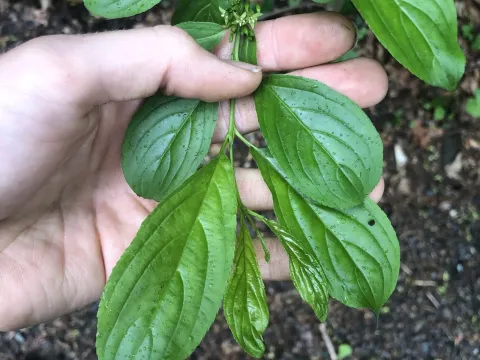
Dahurian buckthorn
Rhamnus davurica
Dahurian buckthorn belongs to the Rhamnaceae family. Propagation is primarily carried out through seeds, which require stratification for 2–3 months at low temperatures to improve germination rates significantly.
What the section contains
Dahurian buckthorn
Sowing in nurseries is performed either in late autumn or spring. When sown before winter, natural stratification occurs in the soil, which helps ensure uniform seedling emergence as soon as the weather warms up.
Seeds are typically sown at a depth of 2–3 centimeters in light, fertile substrate. Maintaining adequate soil moisture during the germination period is critical to prevent the young seedlings from drying out and perishing.
For vegetative propagation, hardwood cuttings are harvested during the plant's dormant period. These cuttings are planted in sheltered ground using rooting stimulants to ensure successful establishment and faster root development.
The optimal planting pattern depends on the intended use—when creating dense hedges, an interval of 0.5–1 meter is recommended, while for medicinal plantations, rows should be spaced 2–3 meters apart.
This shrub is highly light-demanding and cold-hardy, well-adapted to continental climates. Dahurian buckthorn successfully survives severe winters, making it an excellent candidate for cultivation in northern regions.
The crop has moderate soil requirements but prefers well-drained loams or sandy soils with a neutral or slightly alkaline pH. Waterlogging in the root zone must be avoided, as it can lead to fungal infections and plant death.
In its natural habitat, the plant is found on forest edges, river valleys, and stony slopes. This demonstrates the species' high ecological plasticity and its ability to withstand short periods of drought once established.
To promote active growth in cultivated plantations, regular application of complex mineral fertilizers is recommended. Spring fertilization with nitrogen-based compositions supports vigorous development of green mass early in the season.
Protecting young plants from weed competition is vital during the first years of growth. Regular hoeing and mulching of the root zone help maintain soil moisture and improve aeration for the root system.
The economic value of Dahurian buckthorn lies in its fruits, bark, and leaves, which contain a wide spectrum of bioactive compounds. Fruit yields depend on the plant's age and the quality of agrotechnical care provided.
Mass fruit production begins 4–6 years after planting. The fruits are drupes that turn from green to nearly black upon ripening, accumulating bioactive substances like anthraglycosides.
In pharmacology, the plant's bark is highly valued for its natural laxative properties. Bark harvesting is conducted during the spring sap flow, necessitating strict adherence to sustainable collection practices to maintain plant health.
Beyond its medicinal use, the plant is valued as an excellent honey source. During the flowering period, it attracts large numbers of bees, contributing to the production of high-quality, fragrant honey.
Due to its decorative traits, this culture is often used in landscape design to create dense, hardy hedges. Such hedges are aesthetically pleasing and serve as natural buffers against dust, wind, and noise pollution.
The main threats to Dahurian buckthorn are specific leaf-eating pests. Significant defoliation by larvae can impair the plant's photosynthesis, reducing its vitality and overall productivity throughout the growing season.
In conditions of high humidity and poor canopy ventilation, the plant may be prone to powdery mildew. Preventive measures include proper pruning to ensure free air circulation throughout the shrub's crown.
Root rot poses a danger when watering regimes are mismanaged or when planting in heavy, poorly drained soils. Monitoring groundwater levels is essential when selecting a suitable location for cultivation.
Aphids may infest young shoots during periods of active growth. If early infestations are detected, it is recommended to apply biological insecticides or mild soap solutions to minimize the chemical impact on the crop.
- Adherence to crop rotation principles.
- Timely sanitary pruning.
- Regular phytosanitary monitoring.
- Removal of plant debris in autumn.
- Maintaining a clean root zone area.
Fruit harvesting is performed after full ripening, when the berries acquire their characteristic dark color. It is best to harvest in dry weather to prevent the raw material from spoiling during transport and drying.
Bark is harvested by stripping segments from branches, which must then be dried in well-ventilated rooms or professional dehydrators at temperatures not exceeding 50 degrees Celsius to preserve efficacy.
To prolong shelf life, the dried raw material should be stored in paper bags or cloth sacks. Storage conditions must exclude direct sunlight and maintain low humidity to prevent mold and quality degradation.
For ornamental purposes, formative pruning of the hedge should be carried out in autumn or early spring before the start of the vegetative season. This stimulates side branching, making the shrub denser and more uniform.
Sustainable harvesting of all plant materials is mandatory to ensure the long-term viability of the population. Adhering to professional harvesting techniques guarantees the high quality of raw materials for processing.