
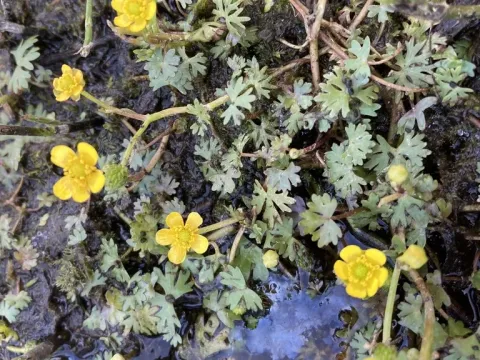
Gmelin's buttercup
Ranunculus gmelinii
Gmelin's buttercup (Ranunculus gmelinii) is a perennial herbaceous plant from the Ranunculaceae family. It is typically found in aquatic or semi-aquatic habitats, demonstrating high adaptability to wetland environments.
What the section contains
Gmelin's buttercup
The plant is widely distributed across the northern hemisphere, inhabiting parts of Eurasia and North America. It thrives in shallow pools, slow-moving streams, muddy shores, and marshes.
This species is well-adapted to cold climates and is recognized for its ability to withstand harsh environmental conditions, often serving as a pioneer species in post-glacial landscapes.
The soil requirements are specific: the plant prefers organic-rich, saturated substrates like silt or peat. Adequate hydration is the most critical factor for its successful growth and reproduction.
Although it is not a traditional field crop, it plays a vital role in wetland biology and local ecosystem stabilization. It is a highly resilient species within its natural ecological niche.
The primary threats to this plant are drainage projects and agricultural land reclamation that destroy its wetland habitats. Loss of water sources leads to the rapid decline of local populations.
Like many members of the Ranunculaceae family, Gmelin's buttercup contains protoanemonin, a toxic substance that serves as a natural defense mechanism against herbivores.
Fungal pathogens associated with water stagnation can affect the plant stems, especially in eutrophic waters where oxygen levels are depleted by excessive algal growth.
Pest pressure is generally low due to the plant's chemical toxicity, making it relatively resistant to common agricultural insect infestations that plague other crops.
Conservation efforts are necessary to protect its biological diversity, as changing climate conditions and water pollution levels can negatively impact its natural distribution range.