
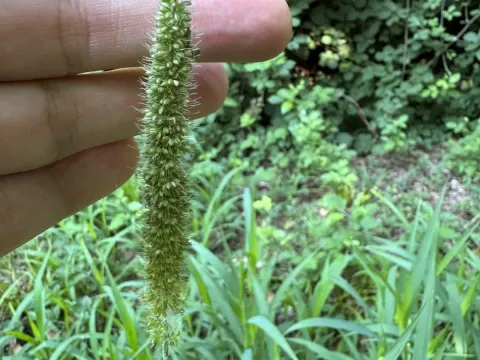
Rough bristlegrass
Setaria verticillata
Rough bristlegrass (Setaria verticillata) is a member of the Poaceae family. This annual grass species is widely recognized as a significant agricultural weed that competes aggressively with various crop systems for water, nutrients, and sunlight.
What the section contains
Rough bristlegrass
The plant thrives in warm, nutrient-rich soils with consistent moisture levels. It is highly sensitive to shading, preferring open, well-lit environments, which is why it often dominates early in the growing season within row-crop systems.
Its natural range encompasses temperate to subtropical regions globally. Due to its high phenotypic plasticity, rough bristlegrass successfully colonizes diverse environments, including cultivated fields, orchards, and disturbed waste areas.
The species is botanically distinct due to its inflorescence, which features stiff, barbed bristles. These barbs act like hooks, allowing the seeds to disperse efficiently by attaching themselves to animals, clothing, or farm equipment.
Regarding its lifecycle, the plant requires relatively high soil temperatures to germinate, typically starting in late spring. It displays rapid biomass accumulation, allowing it to complete its reproductive cycle even under varying seasonal conditions.
The primary economic impact of rough bristlegrass is its ability to significantly suppress crop yields by occupying space and nutrient niches. In high-density infestations, it can lead to total crop failure in susceptible, low-growing cultivars.
The weed serves as an alternative host for several pests and pathogens, including cereal aphids and various fungal diseases that cause leaf spots. This role in pest ecology increases the complexity of maintaining overall crop health.
Management strategies focus on a combination of cultural practices, such as crop rotation and timely cultivation. Preventing seed set is critical, as the soil seed bank can remain viable for several seasons if not properly managed.
Chemical control is often necessary, utilizing selective post-emergence herbicides targeting annual grasses. Careful timing is essential, as the plant becomes significantly more tolerant to chemical applications once it reaches the flowering stage.
Integrated weed management remains the best practice. By combining competitive crop varieties, precise fertilization, and targeted herbicide use, farmers can reduce the pressure caused by this persistent grassy weed effectively.