
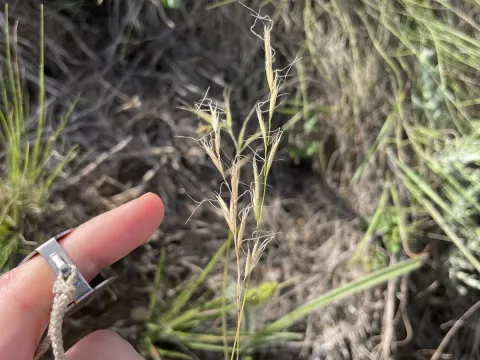
Oatgrass
Helictotrichon imberbe
Helictotrichon imberbe is a perennial herbaceous plant belonging to the Poaceae family. In its natural habitat, oatgrass seeds germinate primarily in the spring when stable positive temperatures are established and the soil warms up to 8–10 degrees Celsius.
What the section contains
Oatgrass
When introduced into cultivation for haymaking or pastures, it is recommended to sow in early spring, which allows plants to maximize the use of moisture accumulated in the soil after snowmelt. This is critical for obtaining uniform emergence and forming a strong root system during the first year of vegetation.
The seeding rate is calculated based on the germination rate of the specific seed batch, typically ranging from 10 to 15 kilograms per hectare. The sowing depth should be between 1.5 and 2.5 centimeters, as sowing too deep in heavy soils can lead to the death of the seedlings.
Soil preparation is a crucial aspect, as the field must be thoroughly cleared of perennial weeds and have a fine-crumb structure. After sowing, it is recommended to roll the field to ensure better contact between the seeds and soil particles and to facilitate capillary moisture flow to the seeds.
In regions with an arid climate, late-autumn sowing is permissible, allowing seeds to undergo natural stratification and germinate as early as possible with the arrival of the first spring days, giving them a development advantage over weeds.
This crop is characterized by high ecological plasticity, although it prefers moderately moist areas with good drainage. Helictotrichon imberbe grows best on loamy and sandy soils that possess sufficient humus content and a neutral or slightly acidic pH level.
The plant exhibits excellent winter hardiness and the ability to withstand short-term spring frosts, making it a promising candidate for use in northern forest-steppe zones. It does not tolerate prolonged water stagnation, therefore areas with a high water table are unsuitable for its cultivation.
Its natural range covers mountainous and foothill regions, where the grass grows on open slopes. In cultivation, it requires good sunlight and does not tolerate heavy shading by other tall grass species, which is why it is more often used in seed mixtures or on open grazing lands.
Helictotrichon imberbe responds well to moderate nitrogen fertilizer applications, which stimulate the growth of vegetative mass during the spring-summer period. Phosphorus-potassium fertilizers are primarily applied during basic soil tillage to strengthen the root system and enhance plant immunity.
Under intensive management, it is important to avoid overgrazing, as the plant can be sensitive to excessive soil compaction caused by livestock. Rotation of grazing plots allows for maintaining high productivity of the sward over many years of use.
Helictotrichon imberbe possesses quite high natural resistance to diseases characteristic of many cultivated cereals, but it can be affected by powdery mildew under unfavorable weather conditions. In years with high air humidity, the development of rust on leaf blades is possible.
Pests such as cereal flies can damage young seedlings during the initial growth phases. Regular monitoring of the crops allows for the timely detection of infestation hotspots and the implementation of protection measures using biological or approved chemical agents.
Root rots can occur with systematic waterlogging of the soil and disruption of aeration in the root zone. Prevention of these diseases involves crop rotation and avoiding conditions that lead to stagnant water in the fields.
Aphids are another potential pest that sucks juice from young leaves, reducing the overall productivity of the grass. In an agroecosystem, their population is often controlled by natural entomophages, such as ladybugs and lacewings.
Overall crop protection should be based on a complex approach, focusing primarily on creating optimal growth conditions for the plant itself. A healthy and robust sward is significantly less likely to be attacked by pests or affected by pathogens.