
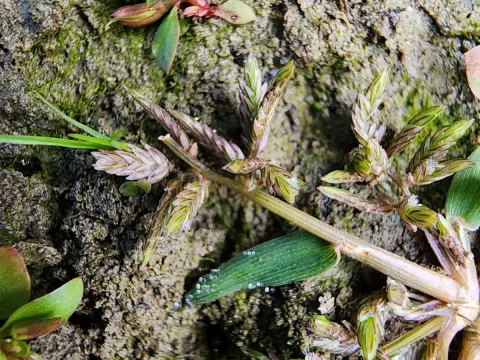
Creeping lovegrass
Eragrostis hypnoides
Creeping lovegrass (Eragrostis hypnoides) is an annual grass belonging to the family Poaceae. The species is recognized for its prostrate growth habit, characterized by stems that spread horizontally and root at the nodes to form dense, mat-like colonies in its native environment.
What the section contains
Creeping lovegrass
The plant is native to the Americas and is widely distributed across various moist habitats. It typically thrives in sandy substrates near riverbanks, lake shores, and floodplains where regular moisture availability is guaranteed throughout the growing season.
Botanically, the plant features narrow, linear leaves that are often pubescent, an adaptation helping it manage transpiration rates. The inflorescence consists of a diffuse panicle with small, numerous spikelets, enabling the plant to produce a significant quantity of seeds for successful colonization.
The species requires moist, well-drained soils and high levels of solar radiation to achieve optimal biomass production. While it shows remarkable resilience to flooding, it does not tolerate extended drought periods, which limits its primary range to areas with consistent moisture supply.
Economically, Creeping lovegrass is valued primarily for its role in ecological restoration and soil erosion control. Its ability to create a dense vegetative cover makes it an excellent choice for stabilizing riparian zones and protecting vulnerable soils from the erosive forces of water.