
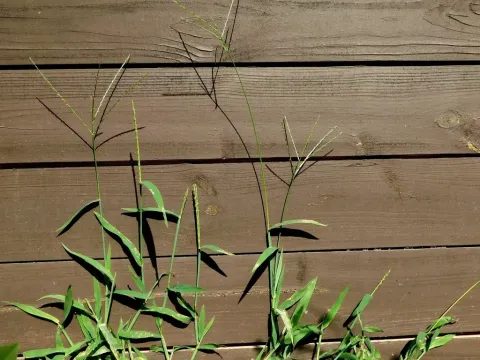
Crabgrass
Digitaria Haller
Sowing of Digitaria (crabgrass) is typically conducted in warmed soil once temperatures reach 15-18°C. Late spring is the optimal window, ensuring that moisture levels are sufficient for uniform germination.
What the section contains
 Digitaria didactyla
 Willd.
Digitaria didactyla
Digitaria didactyla Willd.
 Digitaria eriantha
 Steud.
Digitaria milanjiana
Digitaria milanjiana (Rendle) Stapf
Digitaria eriantha
Digitaria eriantha Steud.
Digitaria milanjiana
Digitaria milanjiana (Rendle) Stapf
 Digitaria scalarum
 (Schweinf.) Chiov.
Digitaria scalarum
Digitaria scalarum (Schweinf.) Chiov.
 Egyptian crabgrass
Digitaria aegyptiaca Willd.
Florida crabgrass
Digitaria floridana Hitchc.
Egyptian crabgrass
Digitaria aegyptiaca Willd.
Florida crabgrass
Digitaria floridana Hitchc.
 Fonio
Digitaria exilis (Kippist) Stapf
Large crabgrass
Digitaria sanguinalis (L.) Scop.
Fonio
Digitaria exilis (Kippist) Stapf
Large crabgrass
Digitaria sanguinalis (L.) Scop.
 Natal fingergrass
Digitaria natalensis Stent
Natal fingergrass
Digitaria natalensis Stent
 Sourgrass
Digitaria insularis (L.) Fedde
Sourgrass
Digitaria insularis (L.) Fedde
 Southern crabgrass
Digitaria ciliaris (Retz.) Koeler
Swaziland fingergrass
Digitaria swazilandensis Stent
Southern crabgrass
Digitaria ciliaris (Retz.) Koeler
Swaziland fingergrass
Digitaria swazilandensis Stent
 Velvet crabgrass
Digitaria velutina (Forssk.) P. Beauv.
Velvet crabgrass
Digitaria velutina (Forssk.) P. Beauv.
Crabgrass
Seed planting depth should be shallow, around 1-2 centimeters, as the seeds are extremely small. Excessive depth significantly reduces germination energy and leads to sparse crop establishment.
Seeding rates are determined by the chosen planting method and seed quality. A row planting technique with spacing up to 15 centimeters is generally preferred for creating a uniform stand of forage.
Rolling the soil after seeding is highly recommended to ensure firm contact between the seeds and the soil, facilitating capillary moisture movement for the developing seedlings.
While regional weather conditions may dictate slight timing adjustments, it is critical to complete the sowing process before the arrival of extreme summer heat to allow the plants to establish a robust root system.
Digitaria, belonging to the Poaceae family, is noted for its adaptability to various soil types. It performs best in well-drained sandy and loamy soils where waterlogging is not an issue.
The crop is highly dependent on light and does not tolerate shading. To achieve efficient photosynthesis and biomass accumulation, it requires full, direct sun exposure throughout the day.
Although it possesses moderate drought tolerance, maximum yield is achieved with regular precipitation. During the peak vegetative phase, adequate nitrogen availability in the soil is essential.
The optimal pH range for successful cultivation is between 5.5 and 7.0. Productivity is notably reduced in highly saline or waterlogged environments where nutrient uptake is inhibited.
Temperature is a defining factor in development; crabgrass is a warm-season grass that grows most vigorously when daily temperatures remain consistently above 20-25°C.
The green mass yield of Digitaria fluctuates based on the level of agronomic care and water availability. Under intensive management, multiple cuts (2-3 per season) can be obtained.
Productivity increases significantly under irrigation compared to rain-fed systems. Irrigation facilitates a faster regeneration rate, allowing for multiple harvests throughout the growing season.
The timely application of mineral fertilizers, particularly nitrogen, is vital. Post-harvest fertilization supports the rapid recovery of vegetative biomass and sustains plant health.
Due to its biological plasticity, Digitaria is suitable for both monoculture planting and inclusion in forage seed mixtures. Mixed stands often demonstrate higher overall yield stability.
Seed yield is heavily influenced by the plant's development stage and weather patterns during maturation. Successful seed harvesting requires careful moisture management during threshing.
The crop is susceptible to various rusts and leaf spot diseases, especially under conditions of high humidity and poor ventilation within the canopy. Crop rotation is essential for disease mitigation.
Among pests, grass flies and aphids present the greatest risk. These insects damage tender shoots and inflorescences, potentially causing significant yield losses if infestations reach threshold levels.
Nematodes may also negatively impact root development. Utilizing certified, disease-free seed and practicing soil sanitation are primary methods for preventing underground pest colonization.
Weed competition is most severe during the initial growth stages. Early manual weeding or the use of selective herbicides helps alleviate stress and promotes vigorous crop development.
Regular field scouting is recommended, particularly during periods of fluctuating temperatures and high humidity, which create optimal conditions for the proliferation of fungal pathogens.
Harvesting for green fodder should occur during the booting or early heading stage. During this period, the plant contains the highest concentration of essential nutrients for livestock feed.
When harvesting for hay, mowing must be completed before the stems become overly fibrous and lignified. Delayed harvesting significantly reduces the digestibility and nutritional quality of the forage.
For seed harvesting, it is critical to wait for full maturity of the panicles. Given that crabgrass seeds can shatter easily, rapid processing using specialized machinery is required.
Once mown, the material is left in windrows for moisture reduction if hay quality is the objective. Constant monitoring prevents self-heating and loss of material quality in storage.
The harvested crop must be stored in well-ventilated structures to prevent spoilage. Adhering to professional harvesting protocols preserves the biochemical value of the crop for long-term use.