
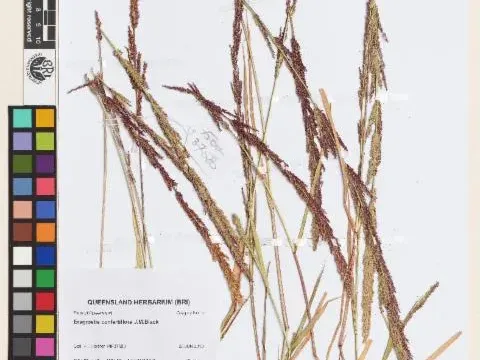
Eragrostis confertiflora
Eragrostis confertiflora
Sowing of Eragrostis confertiflora is ideally performed in the spring once the soil temperature reaches at least 15–18 degrees Celsius, ensuring a frost-free environment for germination.
What the section contains
Eragrostis confertiflora
Due to the extremely small size of the seeds, the sowing depth must be kept shallow, typically between 1 and 2 centimeters, followed by light rolling to ensure soil contact.
The seeding rate varies based on the intended use, such as grazing or hay production; higher rates are often recommended to establish a dense sward quickly.
Seedbed preparation is critical, as the crop is initially slow-growing and requires a weed-free environment to establish itself without competition from faster-growing species.
Overseeding into existing pastures is possible, though it requires scarifying the existing turf to reduce competition and ensure the seedlings have adequate light and space to sprout.
Eragrostis confertiflora is a member of the Poaceae family, recognized for its heat-loving nature and excellent adaptation to regions with long daylight hours and high solar radiation.
The species demonstrates remarkable drought tolerance, possessing a robust root system that accesses moisture from deeper soil layers, making it ideal for semi-arid environments.
It thrives best in well-drained sandy or sandy-loam soils. Heavy clay soils with poor aeration are generally unsuitable, as they restrict root development and decrease total biomass yield.
While adapted to nutrient-poor soils, the crop responds positively to nitrogen fertilization, which should be applied in split doses throughout the growing season to maximize forage output.
The optimal pH range for this species is between 5.5 and 7.0, although it shows high phenotypic plasticity regarding different soil types and chemical compositions.
The yield potential of Eragrostis confertiflora depends on the level of management and local environmental conditions, with the possibility of achieving up to three harvests per season.
When managed for hay, dry matter yields typically range from 40 to 60 quintals per hectare, depending on moisture availability and the fertility level of the field.
The crop's biological resilience allows it to recover quickly after grazing or mechanical mowing, making it a reliable resource for sustainable pasture-based livestock farming.
Nutritional value remains high when harvested at the vegetative stage, before the stems begin to lignify and the plant diverts energy toward the production of seeds.
Peak productivity is usually observed from the second year onwards, once the root system has fully established and the plant is capable of rapid regrowth after harvest.
The crop displays strong natural resistance to many common fungal diseases affecting grasses, which significantly reduces the need for frequent chemical intervention in the field.
Primary pests include wireworms and aphids, which can cause damage to the root system or sap-sucking injury on the leaves during the initial stages of vegetative growth.
Root rot may occur in instances of waterlogging or poor soil drainage, making the choice of the planting site the most important factor in disease prevention.
Weeds pose a significant threat during the establishment phase. Effective monitoring and occasional control are necessary to prevent weed infestation from overtaking the field.
Implementing a crop rotation strategy is an effective way to mitigate pest buildup and maintain healthy soil conditions for long-term production of the crop.
Hay harvest should ideally occur at the late vegetative or early heading stage to maintain the best balance between biomass quantity and protein quality for livestock.
For seed production, the harvest is performed at full maturity; care must be taken to minimize grain loss, as the small seeds can scatter easily during mechanical harvesting.
Standard mowing equipment is effective, and the harvested biomass should be dried promptly to reach the desired moisture content for storage in bales or rolls.
The crop's preference for warm weather facilitates rapid field drying, which helps preserve nutrients and reduces the risk of spoilage during the curing process.
Post-harvest maintenance, such as field clearing and light harrowing, can stimulate tillering and improve the health of the regrowth for the following harvest or autumn grazing.