
Eragrostis echinochloidea
Eragrostis echinochloidea
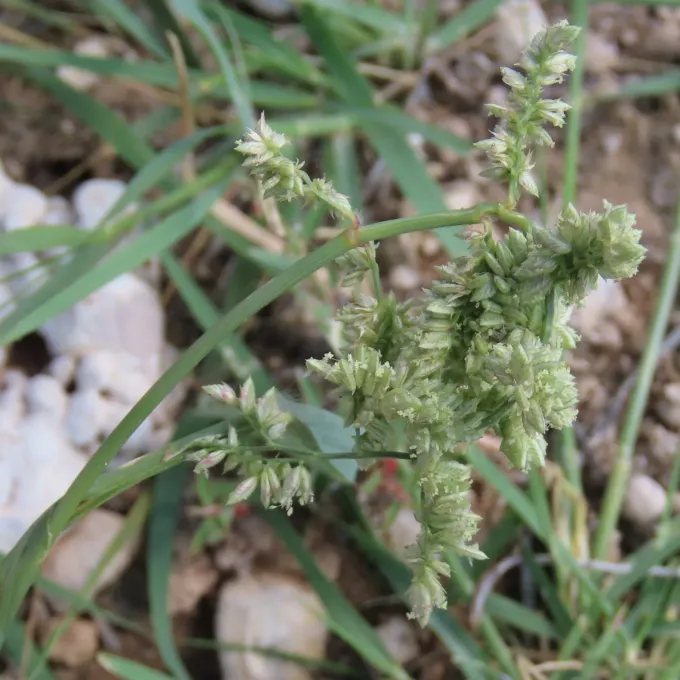
Description
Sowing dates
Eragrostis echinochloidea is a perennial grass species belonging to the Poaceae family. It is recognized for its hardiness and ability to thrive in environments where typical forage grasses struggle to survive.
Sowing should take place when soil temperatures are consistently above 15 degrees Celsius. In its native range, the start of the rainy season provides the ideal window for seed germination and root establishment.
Because the seeds are very fine, they should be sown shallowly, at a depth of no more than 1–2 centimeters. Direct contact with the soil is essential, often achieved through light harrowing and rolling.
Establishing a uniform stand requires careful management of seed distribution. Utilizing specialized small-seed drills ensures that the crop is evenly distributed across the field to prevent overcrowding.
Proper timing of planting is crucial to allow the root system to develop before the onset of the peak dry season, ensuring the long-term survival and productivity of the pasture.
Growing requirements
Originating from African ecosystems, this species is well-adapted to high-temperature conditions. It is classified as a xerophyte, showing remarkable resilience in arid and semi-arid environments.
The grass performs best on well-drained sandy or loamy soils. It has a high tolerance for nutrient-poor substrates, making it an excellent candidate for land restoration projects in difficult soil conditions.
Ample sunlight is a primary requirement for this crop. Shaded areas significantly limit the growth of tillers and the overall accumulation of biomass, which is counterproductive for forage purposes.
It displays high drought tolerance, quickly resuming growth as soon as moisture becomes available. This metabolic efficiency makes it a reliable resource in regions with unpredictable rainfall patterns.
While it does not demand heavy fertilization, supplemental nitrogen during the early stages of growth can significantly boost the stand's density and nutritional profile for livestock.
Yield
The primary use of Eragrostis echinochloidea is as a source of high-quality forage for grazing or hay production. It maintains good yields even in conditions that would cause other grasses to fail.
The yield of green biomass depends heavily on the frequency of rainfall and soil quality. Under optimal conditions, multiple cuts per season are possible, provided the plants are allowed sufficient recovery time.
Nutritional value is highest before flowering. Management strategies should prioritize harvesting or grazing during the vegetative phase to ensure the livestock receives the highest protein content.
Effective pasture management includes rotational grazing. This practice not only maximizes the yield over the long term but also prevents overgrazing and the depletion of the plant's root reserves.
Consistent productivity over several years makes it a preferred species for livestock farmers seeking to establish permanent pastures in regions prone to periodic water shortages.
Main diseases and pests
Eragrostis echinochloidea is known for its robust health and general resistance to common fungal and bacterial diseases that plague other grasses. This inherent strength reduces the need for chemical treatments.
Pests are rarely a significant problem, although local infestations of insects during extreme heat waves can occur. Regular monitoring helps in identifying these issues early if they arise.
The most significant threat to the plant's health is prolonged waterlogging. Poorly drained soils can cause root asphyxiation and encourage the growth of harmful soil-borne pathogens.
Prevention of disease is mostly achieved through sound agronomic practices, such as maintaining correct planting density and ensuring the site selected has excellent natural drainage properties.
In cases of heavy pest pressure, biological control methods are preferred over broad-spectrum pesticides to maintain the ecological balance of the pasture and the safety of the livestock.
Harvesting
Hay harvesting should be executed at the onset of the flowering phase. Timing is critical to balance the volume of biomass with the nutritional quality required for animal feed.
Stubble height is of utmost importance for the perennial nature of the crop. A cutting height of 5–7 centimeters is recommended to ensure that the crown remains undamaged for rapid regrowth.
The fine-textured foliage of the grass allows for efficient drying after cutting. This minimizes the time spent in the field and reduces the risk of nutrient leaching from unexpected weather events.
Seed harvesting should be performed when the panicles show signs of maturity, typically indicated by a color change from green to a yellowish or light brown hue.
Proper storage of hay in moisture-free environments is necessary to prevent spoilage. Ventilation in storage units ensures the feed maintains its palatability and nutritional value for winter consumption.