
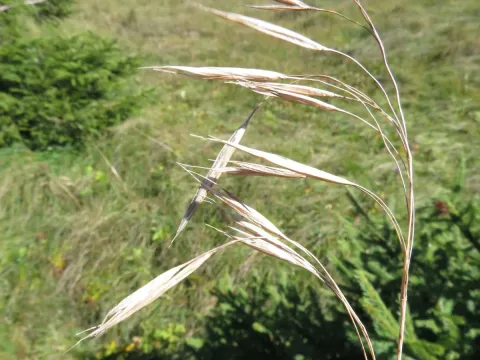
Pannonian brome
Bromus pannonicus
Sowing Pannonian brome is ideally performed in early spring, taking advantage of soil moisture reserves to ensure rapid and uniform germination. Autumn sowing is also a viable option in milder climates, allowing the seeds to undergo natural stratification over the winter period.
What the section contains
Pannonian brome
A standard row-drilling method with 15 cm spacing is recommended for general forage establishment. However, for seed production fields, spacing should be increased to 45–60 cm to promote better sunlight penetration and air circulation, which are essential for developing robust panicles.
The seeding rate typically ranges from 12 to 16 kg per hectare, adjusted based on seed purity and germination capacity. For soil stabilization on slopes or erosion-prone areas, rates may be increased to create a denser turf that effectively protects the soil surface.
Seed depth should be kept shallow, between 2 and 3 cm, to prevent exhausting the energy reserves of the emerging seedlings. On heavy clay soils, seeds should be placed shallower, while on lighter sandy soils, a slightly deeper placement helps keep the seeds in moist contact.
Post-sowing rolling with a cultipacker is a critical step in the establishment process. This practice ensures firm soil-to-seed contact, which is vital for achieving consistent emergence, especially in fields where surface moisture levels may be volatile during the germination window.
Pannonian brome belongs to the Poaceae family and is a resilient perennial grass adapted to temperate climates. Its ability to thrive in diverse environments makes it a highly valuable species for agricultural systems aiming at sustainable forage production.
This species is well-known for its drought tolerance, supported by a deep and efficient root system that allows it to access subsoil moisture. These characteristics make Pannonian brome an excellent candidate for inclusion in forage mixtures in regions prone to periodic dry spells.
While relatively hardy, it performs best on fertile loamy or chernozem soils with a neutral to slightly alkaline pH. The plant exhibits good tolerance to moderate soil salinity, which provides additional options for utilizing land that might be challenging for less adaptable species.
As a heliophilic (sun-loving) plant, it requires open, well-lit sites to maximize biomass production. Shaded conditions significantly reduce the growth rate and yield potential, highlighting the importance of site selection when establishing new stands for hay or grazing.
Cold hardiness is one of the key strengths of Pannonian brome, enabling it to withstand harsh winters without significant plant loss. The longevity of the stand remains high over several years, providing stable returns for farmers throughout the lifespan of the field.
The yield of Pannonian brome is highly responsive to sound agronomic management and adequate nutrient availability, particularly nitrogen application. Under optimal conditions, the crop can produce two robust cuts per season, offering consistent biomass production.
Typical dry matter yields range between 4 and 7 tonnes per hectare, depending on soil quality and field age. With intensive management and strategic fertilization, these figures can be significantly improved, making the crop a profitable addition to forage-based operations.
Seed production is reliable, providing an opportunity for self-sufficiency in seed supply. With proper care of seed-dedicated stands, yields of 0.4 to 0.6 tonnes of clean seeds per hectare can be consistently achieved under favorable weather conditions.
Productivity tends to peak between the third and fourth year of the stand's life. Farmers often implement rejuvenation practices or overseed with legumes as the stand matures to maintain yield levels and ensure the longevity of the forage resource.
The nutritional quality of the forage is characterized by high protein and carbohydrate content, making it highly digestible for ruminants. Integrating Pannonian brome into livestock diets supports improved weight gain and overall animal health during the production cycle.
Powdery mildew is a common concern, particularly in seasons with high humidity. The appearance of a white fungal layer on the leaves can reduce the forage quality and overall plant vigor, necessitating careful management of stand density to improve air circulation.
Rust diseases may also affect the foliage, limiting the photosynthetic capacity of the plant. Mitigation strategies include selecting resistant germplasm, maintaining healthy crop rotation, and applying fungicides when disease pressure exceeds economic thresholds.
Various insect pests, such as cereal flies and plant bugs, can cause damage during the early growth stages or during panicle development. Regular scouting during the shooting and heading phases is essential to identify infestations and take appropriate remedial action.
Root rots are generally associated with poorly drained soils or waterlogged conditions. Selecting well-drained sites for establishment and avoiding excessive irrigation are the primary ways to prevent soil-borne pathogens from compromising the root system.
An integrated pest management approach, including timely mowing and the control of host weeds in surrounding areas, helps to reduce the incidence of both diseases and pests, minimizing the reliance on chemical treatments while keeping the stand productive.
For high-quality hay, the crop should be harvested at the early heading to early flowering stage. This timing captures the optimal balance of nutrient concentration and fiber content, ensuring maximum digestibility for livestock consumption.
When intended for haylage, harvesting should take place slightly earlier, during the booting stage. Efficient processing and preservation are crucial to retain the high energy density and protein quality that make this grass a superior winter feed option.
Seed harvesting requires close monitoring for maturity, characterized by a transition of the panicles to a straw-yellow color. Harvesting too early results in poor quality, while waiting too long significantly increases the risk of seed shattering and yield loss.
A two-stage harvesting process, involving swathing followed by combine threshing, is often preferred for seed production. This approach allows the crop to cure uniformly in the windrow, reducing harvest losses and resulting in a higher-quality seed sample.
After the final harvest, the regrowth can be utilized for late-season grazing. This not only provides valuable extra forage but also encourages the plant to tiller more effectively, promoting better stand density and vigor for the upcoming growing season.