
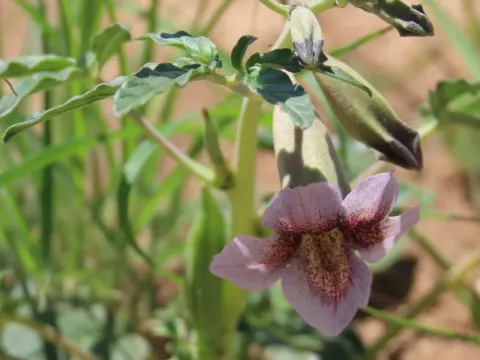
Sesamum triphyllum
Sesamum triphyllum
Sesamum triphyllum is a warm-season crop that requires high soil temperatures for successful germination. Sowing should only occur when soil temperatures consistently reach +20°C to +25°C to ensure rapid seedling emergence.
What the section contains
Sesamum triphyllum
In field conditions, the seeds are typically sown at a depth of 2 to 4 centimeters. Careful depth control is crucial, as planting too deep can lead to exhaustion of seed reserves before the sprout reaches the surface.
Row spacing is generally maintained between 45 and 60 centimeters. This provides sufficient space for the plants to branch out, which is a characteristic feature of this species, and facilitates mechanical weeding operations.
The optimal plant density usually ranges between 100,000 and 200,000 plants per hectare. Achieving this density helps in canopy closure, which eventually suppresses the emergence of competitive weeds.
Choosing the right time for sowing is vital; it should align with the onset of the stable warm season to avoid cold spells that could stunt early development or lead to seedling damping-off.
As a member of the Pedaliaceae family, Sesamum triphyllum is highly adapted to semi-arid environments. Its taproot system allows it to extract moisture from deep soil layers, making it remarkably drought-tolerant.
The crop thrives in well-drained, light-textured soils such as sandy loams. It is extremely sensitive to waterlogging; therefore, avoiding low-lying fields with poor drainage is essential for successful cultivation.
Full sun exposure is a non-negotiable requirement for this plant. Any significant shade, whether from neighboring weeds or nearby trees, will drastically reduce photosynthesis and overall grain yield.
Temperature requirements are high, with the ideal range being between +25°C and +35°C throughout the growing season. The plant exhibits minimal growth if temperatures fall consistently below +20°C.
Regarding soil fertility, phosphorus and potassium are the primary drivers of reproductive growth. Nitrogen should be applied sparingly, as excessive amounts tend to promote excessive foliage at the expense of seed production.
Root rot and fusarium wilt are the most common pathological threats, especially in areas where soil moisture management is poor. Implementing a crop rotation strategy is the most effective preventative measure.
Pests such as the capsule borer and various aphid species pose significant risks. They not only damage the vegetative parts but can also directly reduce the quantity of seeds by attacking the developing capsules.
Early-stage weed control is critical because the crop exhibits slow initial growth and is easily outcompeted by aggressive weeds in the first few weeks after emergence.
Managing the risk of insect infestation involves regular field scouting and the strategic application of biological or chemical pesticides only when necessary to preserve beneficial insects.
- Treating seeds with appropriate fungicides before planting.
- Maintaining a strict 3-year crop rotation schedule.
- Using certified seeds to reduce the risk of seed-borne diseases.
Harvesting Sesamum triphyllum is a delicate task due to the dehiscence nature of the capsules, which tend to shatter easily upon maturity. The timing should be precise to minimize field losses.
The harvest phase typically begins when the bottom capsules turn brown and the leaves start to yellow and drop. The most common practice is to cut and bundle the plants for field curing before threshing.
During the curing process, the plants are stacked to complete the drying of seeds while the capsules finish maturing. This method ensures uniform quality and high oil content in the final product.
Mechanical threshing must be adjusted to a lower drum speed to prevent seed breakage. Handling the crop gently during transport and threshing is key to maintaining product purity and high market value.
Once threshed, the seeds must be cleaned of all debris and dried down to a moisture content below 9% before being placed into long-term storage facilities.