
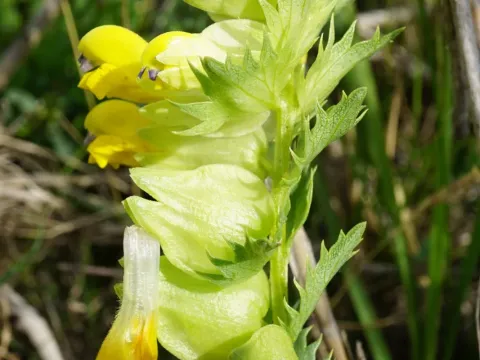
Borbas' yellowrattle
Rhinanthus borbasii
Borbas' yellowrattle (Rhinanthus borbasii) is an annual plant belonging to the Orobanchaceae family. As a hemi-parasite, it establishes symbiotic-like attachments via haustoria to the roots of host grasses, from which it extracts water and nutrients.
What the section contains
Borbas' yellowrattle
The plant originates from the Eurasian steppe and forest-steppe zones. It thrives in open, sunny habitats such as meadows, pastures, and woodland edges where grass density is suitable for host attachment.
Regarding soil requirements, this species prefers nutrient-rich, well-drained soils with a near-neutral pH level. It is sensitive to waterlogged conditions, which inhibit the development of its root system and haustorial efficiency.
Climate adaptability is a core feature of the species, as it is well-suited to temperate zones with distinct seasonal temperature variations. It relies on a period of cold stratification for successful germination in early spring.
Management in agricultural settings focuses on using Borbas' yellowrattle to enhance meadow biodiversity. By suppressing dominant vigorous grasses, it allows for a higher diversity of flowers and non-grass species to establish within the ecosystem.
Fungal infections, particularly powdery mildew, are the primary biological threats. These occur predominantly during periods of stagnant humidity and high temperatures in late spring.
Insect pests, specifically those targeting reproductive tissues, can significantly reduce seed yields. Larvae may feed internally within the inflated seed capsules, damaging the plant's ability to propagate.
Competition from fast-growing weeds can be a significant threat in the early stages of development. Proper site selection and initial management are vital to ensure the young seedlings receive adequate light.
Excessive application of chemical fertilizers, particularly nitrogen-heavy compounds, may disrupt the delicate balance between the host grass and the hemi-parasite, leading to reduced survival rates.
Effective control measures in non-target areas involve early-season mowing, which prevents the maturation of seed pods and successfully limits the spread of the population in the following year.