
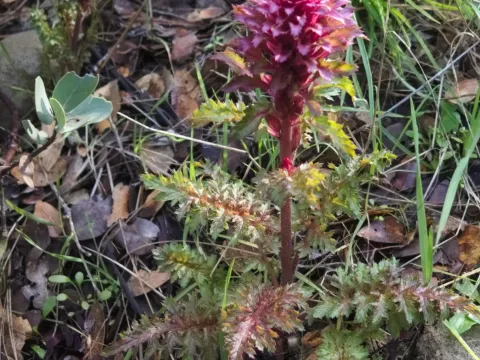
Lousewort
Pedicularis
Lousewort (genus Pedicularis) is a group of perennial herbaceous plants belonging to the Orobanchaceae family. These plants are known as hemiparasites, meaning they produce chlorophyll but also derive water and nutrients from the roots of host plants via specialized structures called haustoria.
What the section contains
 Pontic lousewort
Pedicularis pontica
Pontic lousewort
Pedicularis pontica
 Pyrenean lousewort
Pedicularis pyrenaica
Pyrenean lousewort
Pedicularis pyrenaica
 Short-leaved lousewort
Pedicularis brevifolia
Short-leaved lousewort
Pedicularis brevifolia
 Sibthorp's lousewort
Pedicularis sibthorpii
Sibthorp's lousewort
Pedicularis sibthorpii
 Spike lousewort
Pedicularis spicata
Spike lousewort
Pedicularis spicata
 Swamp lousewort
Pedicularis lanceolata
Swamp lousewort
Pedicularis lanceolata
 Tuberous lousewort
Pedicularis tuberosa
Tuberous lousewort
Pedicularis tuberosa
 Wood lousewort
Pedicularis sylvatica
Wood lousewort
Pedicularis sylvatica
 Yezo lousewort
Pedicularis yezoensis
Yezo lousewort
Pedicularis yezoensis
Lousewort
The distribution of Pedicularis spans across the temperate and arctic regions of the Northern Hemisphere. They are typically found in moist meadows, wetlands, heathlands, and alpine tundras where the availability of suitable host plants is consistent.
The habitat requirements for lousewort are strict regarding soil moisture and local biodiversity. They thrive in acidic to neutral, well-drained but permanently moist soils, which support a variety of grasses and forbs that serve as hosts for the hemiparasite.
Regarding climate, lousewort prefers cool to temperate conditions. It requires a distinct growing season, often benefiting from early snowmelt or consistent rainfall that keeps the substrate hydrated throughout the development phase of the plant.
As a non-cultivated plant species, there is no standardized agricultural practice for lousewort. Research focuses primarily on conservation biology, aiming to restore natural habitats where these plants play a vital role in maintaining ecological balance.
Major threats to lousewort populations include land drainage, intensive agriculture, and land-use changes that remove the specific host species on which lousewort depends for survival. Habitat fragmentation is a significant risk factor.
Common diseases affecting lousewort include fungal pathogens, particularly those responsible for rusts and leaf spots. These infections are more prevalent in high-humidity areas with poor air circulation between plants.
Insects like aphids and specialized larvae of moths often feed on lousewort foliage. While they can weaken individual plants, these herbivores are typically part of a balanced food web and do not cause large-scale devastation in healthy ecosystems.
Environmental stress, such as drought or chemical contamination, can disrupt the delicate haustorial connection between the lousewort and its host. This leads to reduced growth rates and lower seed production for the season.
Protecting these plants requires a holistic approach that includes preventing the encroachment of invasive species and maintaining the integrity of the soil microbiome, which is essential for the symbiotic and parasitic interactions involved.