
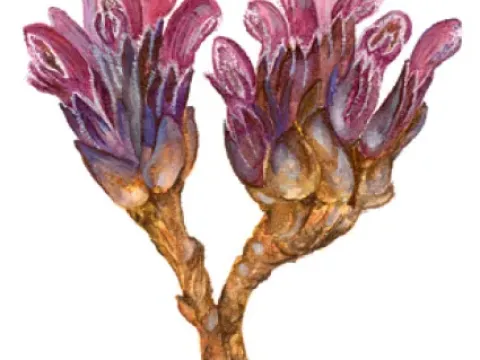
Mannagettaea
Mannagettaea
Mannagettaea is a distinct genus of parasitic plants belonging to the Orobanchaceae family. As holoparasites, these plants lack chlorophyll and cannot perform photosynthesis, relying entirely on a host plant for water, minerals, and essential organic nutrients.
What the section contains
Mannagettaea
The native range of Mannagettaea is primarily concentrated in the mountainous forest regions of East Asia, particularly in China. These plants are highly specialized, typically infesting the roots or stems of specific host species within their native ecosystems.
Botanically, they are characterized by succulent, fleshy stems covered in scale-like leaves. The visible part of the plant emerges only during the flowering stage, while the vegetative parts remain embedded within the tissues of the host organism throughout the year.
Regarding cultivation, Mannagettaea does not have agricultural utility due to its obligate parasitic nature. Its lifecycle is strictly dependent on the physiological state of the host, making it nearly impossible to propagate outside of its natural wild habitat.
The requirement for specific chemical signals from host plants to trigger seed germination is the most critical factor in their biology. Without these signals, the seeds remain dormant, ensuring they only sprout when a compatible host is within close proximity.
The primary threat to the stability of Mannagettaea populations is habitat loss. Because the plant is an obligate parasite, any decline in the population of its specific host trees immediately leads to a corresponding decline in the parasite itself.
Climate change poses a significant risk, particularly regarding shifts in precipitation patterns. Fleshy stems are vulnerable to extreme fluctuations in soil moisture, which can impede the development of reproductive structures and reduce successful pollination.
Fungal pathogens may cause stem rot when environmental conditions, such as high humidity or stagnant air, become unfavorable for the plant. These infections can be particularly devastating for the succulent flowering spikes of the parasite.
Human activities, including deforestation and land development, represent the greatest threat to the survival of the genus. The destruction of old-growth forest microenvironments effectively eliminates the ecological niche required by the parasite.
Given its rarity and specialized ecological role, Mannagettaea is not a common subject of pest management. However, understanding its susceptibility to environmental stressors remains important for the conservation of biodiversity in its native regions.