
Koch's broomrape
Orobanche kochii
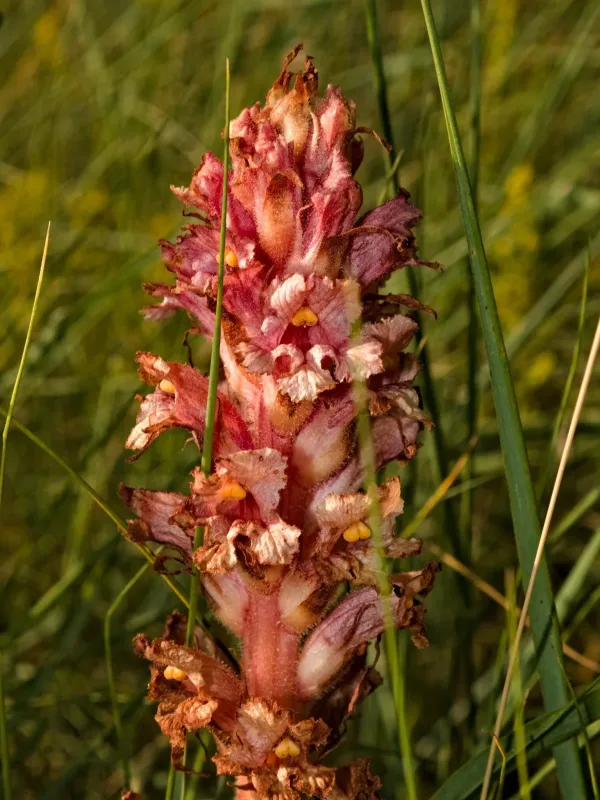
Description
Sowing dates
Koch's broomrape (Orobanche kochii) is a holoparasitic plant belonging to the Orobanchaceae family and is classified as a weed that impairs agricultural crops rather than a crop itself.
Propagation occurs through dust-like seeds that can persist in the soil for many years, waiting for the specific chemical cues from host plant roots to germinate.
The lifecycle begins when the parasite sends a radical towards the host root, forming a connection via haustoria to extract carbohydrates and nutrients.
Successful management strategies focus on preventing the spread of seeds through contaminated machinery and implementing long-term crop rotation.
As an obligate parasite, it relies entirely on the host plant for water and nutrients, which results in the stunted growth of the victim plant.
Growing requirements
This plant species thrives in arid and semi-arid environments where high solar radiation supports its rapid transition to the flowering phase.
It is commonly found in steppe zones and dry meadows, typically clustering around host species belonging to the Asteraceae family.
Soil requirements are relatively broad, provided there is an adequate population of host roots; well-drained, sandy, or light soils are generally preferred.
The climate must be warm enough during the growing season to facilitate the rapid development of the parasite's underground stems and subsequent flowering spikes.
No photosynthesis takes place in this organism, making its growth success contingent on the abundance of nutrients available from the root system of the donor plant.
Main diseases and pests
Natural pathogens, particularly soil-borne fungi such as Fusarium species, can act as biological control agents by attacking the parasite's tissues.
Various insects and larvae that feed on succulent plant tissues may cause physical damage to the flowering stems of the broomrape, reducing seed dispersal.
In agricultural settings, Koch's broomrape is considered a detrimental pest that competes directly with crops, leading to significant yield losses if not managed.
Controlling this parasite is challenging because it is deeply integrated into the host's vascular system, making selective herbicide application difficult.
Preventive measures, including the use of resistant crop varieties and strict quarantine of agricultural fields, are the primary defenses against its proliferation.