
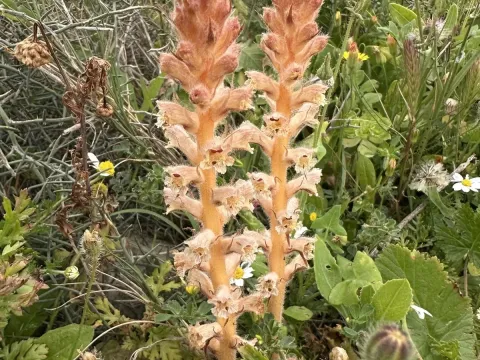
Orobanche pubescens
Orobanche pubescens
Orobanche pubescens, commonly known as a type of broomrape, is an obligate holoparasitic plant belonging to the Orobanchaceae family. As it completely lacks chlorophyll, the plant is incapable of photosynthesis and must rely entirely on the root systems of its host plants to survive and reproduce.
What the section contains
Orobanche pubescens
The native distribution of this species spans the Mediterranean region, Western Asia, and parts of Southern Europe. It thrives in semi-arid environments, often targeting diverse plant families such as Asteraceae, Solanaceae, and Fabaceae, which include various economically significant crops like sunflowers and tomatoes.
The germination of its seeds is strictly dependent on chemical stimuli called strigolactones, which are exuded by the roots of potential host plants. Orobanche pubescens seeds are microscopic and can remain dormant in the soil for over a decade, waiting for the right conditions—specifically the presence of a compatible host root in close proximity.
Botanically, the plant is characterized by a stout, densely pubescent (hairy) stem, which gives it its specific name. The inflorescence is a dense spike featuring blue or yellowish flowers. Instead of true roots, the plant develops haustoria—specialized organs that penetrate the host's root tissue to tap into its vascular system.
From an agricultural standpoint, Orobanche pubescens serves no beneficial purpose and is strictly categorized as a serious noxious weed. It can inflict severe economic losses, as a single plant can produce an immense number of seeds, facilitating rapid spread across cultivated fields and complicating standard agricultural operations.
The primary threat posed by Orobanche pubescens is the direct drain of essential nutrients, water, and photosynthates from the host crop. Infested crops typically show stunted growth, wilting, leaf chlorosis, and, in severe cases, total crop failure, leading to massive financial losses for farmers in affected regions.
Integrated weed management is crucial for control. This includes the use of "trap crops"—plants that stimulate broomrape seed germination without allowing the parasite to attach, thereby depleting the soil seed bank. Rotation with non-host crops is also a standard practice to disrupt the parasite’s lifecycle.
Chemical control options are limited due to the physiological connection between the parasite and the host. Modern strategies often involve the use of herbicide-tolerant crop varieties, allowing for the application of broad-spectrum herbicides that eliminate the broomrape while the crop remains unaffected.
Phytosanitary measures are essential to prevent the spread of broomrape seeds via agricultural machinery. Thorough cleaning of equipment and tractors moving between infested and clean fields is critical, as the microscopic seeds can easily be transported in soil residues and hidden under carriage parts.
- Implementation of strict quarantine regulations.
- Usage of host-resistant crop cultivars.
- Biological control using specialized fungal pathogens.
- Mechanical removal of stalks before seed set.
Long-term research focuses on the genetic improvement of crops to confer innate resistance to broomrape attachment. These breeding programs aim to create varieties that can block the parasite's penetration mechanism, offering a sustainable solution to what remains a persistent challenge in modern agriculture.