
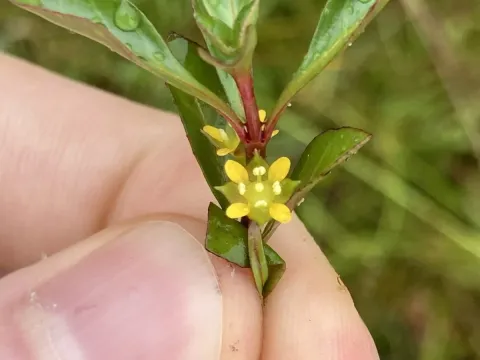
Creeping primrose-willow
Ludwigia repens
Ludwigia repens, commonly known as creeping primrose-willow, is a significant member of the Onagraceae family. Originating from North and Central America, this plant is well-adapted to thriving in wetlands, swamps, and along the margins of various water bodies where it can grow in both submerged and emersed states.
What the section contains
Creeping primrose-willow
Botanically, it is defined by a creeping or ascending stem structure that produces roots from nodes. Its leaves are opposite and vary in shape from elliptical to ovate. The plant is highly valued for its coloration, which shifts from vibrant green to deep red depending on the light intensity and nutrient availability in the substrate and water column.
Cultivation requires specific environmental parameters: water temperature should be kept between 20°C and 28°C. The species thrives in a pH range of 6.0 to 7.5 and prefers moderately soft water. Providing a nutrient-rich substrate is beneficial for root development, although the plant readily absorbs nutrients through its leaves.
Light is the most critical factor for the aesthetic maintenance of the species. It requires high-intensity lighting to preserve its distinct red pigmentation. A photoperiod of 10 to 12 hours is recommended to ensure robust growth and prevent the stem from becoming leggy or losing its lower foliage.
Commercially, Ludwigia repens is a staple in the aquarium trade. It is widely used in aquascaping to provide mid-ground or background focal points. Its rapid growth rate and ease of propagation through stem cuttings make it a highly sustainable and profitable crop for aquatic nurseries and hobbyist breeders.
Algae proliferation, particularly hair algae and black beard algae, poses a significant threat to the health of the plant. These pests compete for light and nutrients, often smothering the foliage and inhibiting the photosynthesis process of the Ludwigia.
Nutrient deficiencies represent a major physiological threat. Specifically, iron deficiency manifests as chlorosis, where the leaf tissues become pale while veins remain green. Without corrective fertilization, the plant's growth will stunt, and the older leaves will eventually decay.
In paludarium settings, terrestrial pests like aphids can be a concern. If the plant is grown emersed, monitoring for sap-sucking insects is necessary to prevent structural damage and the potential transmission of viral diseases that can destroy entire batches of the plant.