
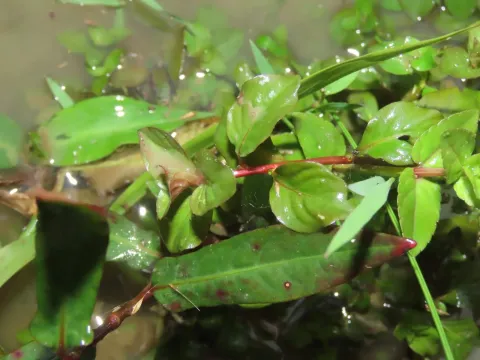
Ludwigia ovalis
Ludwigia ovalis
Ludwigia ovalis belongs to the Onagraceae family and is a prized perennial aquatic plant originating from East Asia. It is native to marshy areas and the fringes of freshwater bodies in Japan, China, and Taiwan, where it thrives in semi-submerged or fully aquatic conditions.
What the section contains
Ludwigia ovalis
Botanically, this species is characterized by its distinct oval-shaped leaves arranged alternately along a flexible stem. The plant is highly sensitive to its environmental conditions, and under high light intensity, its foliage shifts from a standard light green to a striking rose, violet, or deep red hue.
Successful cultivation requires stable water parameters, typically maintaining a temperature between 20°C and 28°C. The plant performs best in slightly acidic to neutral water conditions with a pH level of 6.0 to 7.5, which helps facilitate nutrient uptake and overall metabolic health.
In terms of agricultural and horticultural use, Ludwigia ovalis is primarily cultivated for professional aquarium landscaping and public aquaria. It is highly valued as a mid-ground or background plant due to its ability to create dense, colorful, and visually appealing clusters.
The agronomic management of this plant involves the provision of nutrient-rich substrate and supplemental iron fertilization to maintain its vibrant coloration. Consistent carbon dioxide injection is strongly recommended for those aiming to achieve rapid and healthy growth patterns in an aquatic setting.
Ludwigia ovalis is susceptible to various algal outbreaks, particularly when lighting and nutrient levels are imbalanced. Green spot algae and filamentous algae are the primary competitors that can overwhelm the plant if the water column contains excessive nitrates or phosphates.
Improper maintenance, such as inadequate iron levels, frequently leads to chlorosis and the premature degradation of the lower leaves. Furthermore, sudden fluctuations in water hardness or pH levels can trigger leaf decay, significantly weakening the plant's structural integrity and aesthetic value.