

Reference · Crops
Lilac
Syringa L.
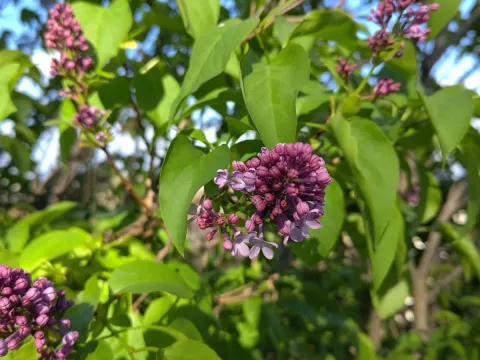
Lilac (Syringa L.) is a prominent genus of flowering woody plants in the olive family (Oleaceae). Originating from the mountain regions of Southeast Europe and East Asia, these shrubs are now cultivated extensively across temperate zones worldwide due to their robust ornamental appeal.
15
items
What the section contains
 Chinese lilac
Syringa x chinensis Willd.
Common lilac
Syringa vulgaris L.
Chinese lilac
Syringa x chinensis Willd.
Common lilac
Syringa vulgaris L.
 Early lilac
Syringa oblata Lindl.
Early lilac
Syringa oblata Lindl.
 Hungarian lilac
Syringa josikaea J. Jacq. ex Rchb.
Hyacinth lilac
Syringa x hyacinthiflora Rehder
Hybrids of Meyer and hairy lilac
hybrids between Syringa meyeri C. K. Schneid. and Syringa pubescens Turcz.
Hungarian lilac
Syringa josikaea J. Jacq. ex Rchb.
Hyacinth lilac
Syringa x hyacinthiflora Rehder
Hybrids of Meyer and hairy lilac
hybrids between Syringa meyeri C. K. Schneid. and Syringa pubescens Turcz.
 Japanese tree lilac
Syringa reticulata (Blume) H. Hara
Japanese tree lilac
Syringa reticulata (Blume) H. Hara
 Komarov's lilac
Syringa komarowii C. K. Schneid.
Komarov's lilac
Syringa komarowii C. K. Schneid.
 Korean lilac
Syringa pubescens Turcz. subsp. patula (Palib.) M. C. Chang & X. L. Chen
Littleleaf lilac
Syringa pubescens Turcz. subsp. microphylla (Diels) M.C. Chang & X.L. Chen
Korean lilac
Syringa pubescens Turcz. subsp. patula (Palib.) M. C. Chang & X. L. Chen
Littleleaf lilac
Syringa pubescens Turcz. subsp. microphylla (Diels) M.C. Chang & X.L. Chen
 Meyer lilac
Syringa meyeri C. K. Schneid.
Nodding Lilac
Syringa komarowii C. K. Schneid. subsp. reflexa (C. K. Schneid.) P. S. Green & M. C. Chang
Meyer lilac
Syringa meyeri C. K. Schneid.
Nodding Lilac
Syringa komarowii C. K. Schneid. subsp. reflexa (C. K. Schneid.) P. S. Green & M. C. Chang
 Pekin lilac
Syringa reticulata (Blume) H. Hara subsp. pekinensis (Rupr.) P. S. Green & M. C. Chang
Pubescent lilac
Syringa pubescens Turcz.
Pekin lilac
Syringa reticulata (Blume) H. Hara subsp. pekinensis (Rupr.) P. S. Green & M. C. Chang
Pubescent lilac
Syringa pubescens Turcz.
 Villous lilac
Syringa villosa Vahl
Villous lilac
Syringa villosa Vahl
Marketplace
Products in this section · 12


Lilac
Optimal growth requires a sunny location with well-drained, fertile soil. Lilacs thrive in neutral to slightly alkaline pH levels and are sensitive to heavy, waterlogged clay soils. Providing excellent drainage is a mandatory requirement to prevent root asphyxiation and subsequent fungal diseases.
The agricultural management of lilacs focuses on consistent pruning and nutritional support. Annual pruning is essential to remove spent flower clusters and promote new wood growth. Proper spacing is critical to maintain air circulation, which significantly reduces the risk of foliar fungal pathogens developing within the foliage canopy.
In commercial and landscape settings, lilacs serve primarily as aesthetic elements, hedges, and screening plants. Beyond their visual utility, they are utilized in the fragrance industry to extract essential oils and as excellent sources of nectar for pollinators in temperate ecosystems.
Nutrient management involves applying balanced fertilizers in early spring as buds begin to swell. Maintaining consistent soil moisture during the first year of establishment is vital, although mature plants are moderately drought-tolerant. Avoid late-summer nitrogen applications to ensure proper lignification before winter dormancy.
Lilacs are frequently challenged by powdery mildew, a fungal infection that covers leaves in white fungal threads, and bacterial blight, which causes sudden wilting of shoots. Effective management requires high-quality plant hygiene and timely application of fungicides during periods of high humidity.
Pest pressures include the lilac borer and various leaf-mining insects that disrupt vascular flow and photosynthetic capacity. Integrated pest management strategies, involving both biological controls and targeted chemical applications, are recommended to maintain plant health and long-term vitality.