
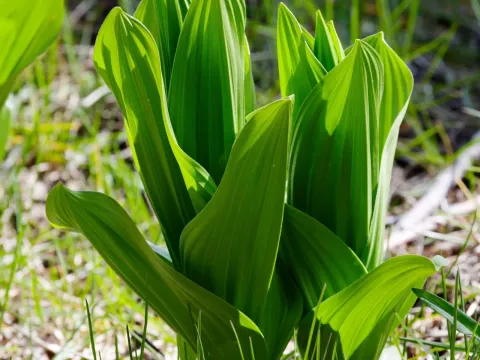
California false hellebore
Veratrum californicum
California false hellebore (Veratrum californicum) is a prominent herbaceous perennial belonging to the Melanthiaceae family. Native to the mountainous regions of Western North America, it thrives in moist meadows, near stream banks, and in subalpine zones.
What the section contains
California false hellebore
The plant grows best in deep, fertile soils that remain consistently moist throughout the growing season. While it is highly cold-hardy and capable of surviving harsh alpine winters under deep snow cover, it requires a cool, humid environment during its active growth phase.
In terms of light, it prefers full sun to partial shade. When cultivating this species, it is essential to ensure that the site has adequate drainage, as stagnant water around the rootstock can trigger root rot and other physiological stressors.
Agrotechnical management involves regular soil monitoring and ensuring that the plant has enough lateral space. Because it is a large plant, spacing should be generous to allow for airflow, which helps in preventing common foliage diseases.
Biological significance of this plant is largely defined by its alkaloid content, particularly cyclopamine. This compound has been extensively studied in embryological research, making the plant a specialized agricultural crop for specific pharmaceutical applications.
Fungal pathogens such as powdery mildew represent a primary threat to the crop, especially in dense plantations where humidity levels are high and the lack of air movement creates a microclimate conducive to spore germination.
Leaf-feeding insects, specifically various species of beetles, can significantly reduce the photosynthetic surface area, impacting the vigor of the plant and the development of its rhizomes over the season.
Soil-dwelling pests, including larvae of click beetles, are known to bore into the fleshy roots, causing mechanical damage and increasing the susceptibility of the plant to soil-borne pathogens.
Integrated pest management (IPM) is crucial for this crop, emphasizing sanitation practices such as the removal of debris and the selection of well-drained planting sites to minimize the incidence of disease outbreaks.
Due to the high toxicity of the plant tissues, any chemical intervention must be carefully evaluated to prevent contamination of the soil and to protect the local ecosystem from unintended side effects of pesticides.