
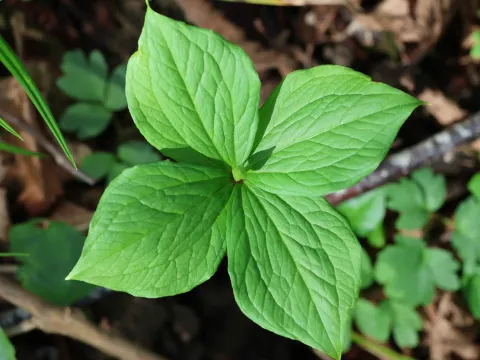
Herb Paris
Paris quadrifolia
Herb Paris (lat. Paris quadrifolia) is a perennial herbaceous plant belonging to the Melanthiaceae family. It is distinctively known for its shade-loving nature, thriving primarily in moist, temperate woodlands where soil moisture levels remain consistently high throughout the growing season.
What the section contains
Herb Paris
The native range of this species covers vast areas of Europe and Northern Asia. It thrives in nutrient-rich forest soils that are characterized by high humus content and a neutral pH level. It cannot tolerate direct sunlight or dry, compacted soil conditions, which restrict its growth significantly.
Botanically, the plant features a rhizomatous root system and a single erect stem topped by a whorl of four broad, ovate leaves. The plant produces a solitary, terminal flower, which later develops into a single, glossy blue-black berry that is highly toxic to mammals and birds.
In terms of agricultural status, Herb Paris is not a domesticated crop. Due to the high concentrations of toxic saponins and glycosides throughout the plant, it poses a significant health risk, making it entirely unsuitable for cultivation in traditional agricultural settings or edible gardens.
Its historical and medicinal utility is limited to specialized pharmaceutical research and homeopathic preparation, strictly under professional supervision. Because of its extreme toxicity, there are no established commercial farming practices, and the focus remains on botanical conservation in its natural habitat.
Herb Paris displays remarkable resistance to common agricultural pests due to its internal chemical defense mechanisms. The primary threats to the plant’s health involve fungal pathogens, particularly those causing root rot in waterlogged environments where the drainage is insufficient to prevent anaerobic soil conditions.