
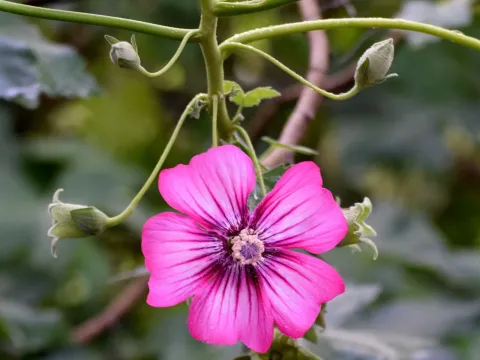
Island mallow
Malva assurgentiflora
Malva assurgentiflora, commonly known as Island mallow, belongs to the Malvaceae family. This woody perennial shrub requires specific propagation methods to ensure successful establishment in a garden or field environment.
What the section contains
Island mallow
Propagation is primarily achieved through seeds, which feature a hard seed coat. Scarification is necessary to improve germination rates. Seeds should be sown in early spring once the soil temperature is consistently above 15°C.
When starting seeds indoors, use a well-draining potting mix and keep the containers in a bright location with temperatures around 20°C. Proper seedling management ensures robust root development before transplanting.
Cuttings can be taken in late summer for vegetative propagation. Using semi-hardwood cuttings treated with rooting hormones in a humid environment significantly increases the success rate of rooting.
The spacing between individual plants should be at least 1.5 meters, as the plant tends to spread significantly. Adequate airflow is crucial to prevent moisture-related issues within the dense foliage.
This species thrives in Mediterranean-type climates, requiring full sun exposure to maintain its growth pattern and flowering potential. It is sensitive to frost, making it ideal for coastal regions or protected garden areas.
Well-drained soil is non-negotiable for Malva assurgentiflora. It prefers sandy or loamy textures that do not hold excess water. Over-saturated soil leads directly to root rot and eventual plant failure.
Watering should be moderate, focusing on consistency rather than volume. During the peak summer heat, deep but infrequent watering encourages deep root growth and increases the overall resilience of the shrub.
Minimal fertilization is usually sufficient. A balanced fertilizer applied in early spring supports healthy growth. Avoid high-nitrogen fertilizers that encourage leafy growth at the expense of flower production.
Pruning is an essential maintenance task. By cutting back the branches after the flowering season, you maintain a compact shape and encourage denser growth for the following year.
The primary threats include fungal diseases such as powdery mildew and rust, especially during periods of high humidity or poor air circulation. Proper sanitation and application of systemic fungicides are recommended treatments.
Aphids and spider mites are common pests that target the younger, tender leaves of the mallow. Regular monitoring and the use of insecticidal soaps are effective methods to manage these infestations early on.
Root rot caused by pathogens such as Phytophthora can occur in poorly drained soils. Preventing this requires diligent soil management and avoiding any form of waterlogging around the plant base.
Slugs and snails can pose a danger to young seedlings and new growth. Implementing physical barriers or organic bait can help mitigate damage during the early stages of plant development.
- Regular inspection of leaves for signs of infestation.
- Improving drainage in heavier soil types.
- Removing fallen plant debris to reduce fungal spread.