
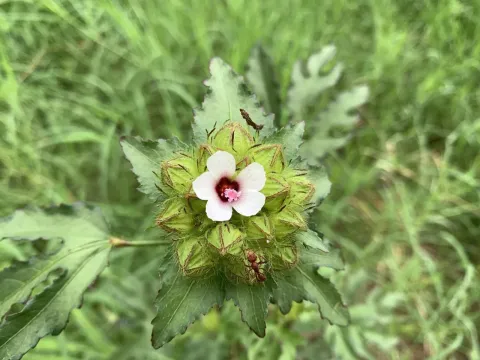
Malachra radiata
Malachra radiata
Malachra radiata is a warmth-loving annual plant, therefore sowing should only be conducted once the soil temperatures have consistently risen above +15...+18°C.
What the section contains
Malachra radiata
In temperate zones with shorter growing seasons, the optimal sowing period is late spring, ensuring that the risk of frost has passed completely.
Seeds are sown in wide rows, maintaining appropriate spacing between rows to ensure that each plant receives sufficient sunlight and air circulation.
The sowing depth should be maintained at approximately 2 to 3 centimeters, depending on the soil moisture and texture, to ensure uniform germination.
Consistent soil moisture in the initial two weeks following planting is crucial for establishing a uniform crop stand and healthy seedling development.
This species belongs to the Malvaceae family and originates from the tropical and subtropical regions of the Americas, influencing its thermal needs.
The crop thrives in hot, sunny conditions with a long growing season, which allows for the accumulation of significant biomass and fiber maturation.
Soils should be fertile, well-drained, and possess a neutral or slightly acidic pH to promote optimal root health and nutrient uptake efficiency.
Although the plant exhibits moderate tolerance to water fluctuations, regular irrigation during peak growth phases is essential for maximizing yield potential.
Nitrogen fertilization is a key agronomic practice, as it significantly boosts stem elongation, which is the primary economic component of this crop.
The primary economic use of Malachra radiata is the extraction of high-quality bast fibers, which are vital for the textile and rope manufacturing industries.
The fibers derived from the stalks exhibit physical and mechanical properties comparable to those of jute or kenaf, making them a versatile industrial material.
The total yield of green biomass depends heavily on the crop density, soil nutrient levels, and the precision of the applied agricultural technology.
Beyond fiber production, the plant serves as a valuable source of cellulose, suitable for the paper industry and various environmentally friendly composite materials.
Seed oil potential and other byproduct uses make Malachra a promising candidate for comprehensive industrial processing and integrated agricultural value chains.
Malachra radiata is susceptible to various fungal diseases during periods of high humidity and poor air circulation, which can cause root and stem rot.
Common pests include several types of leaf-eating insects, such as specific caterpillar species that can significantly reduce leaf area and plant vigor.
Effective management strategies include rigorous crop rotation practices, which prevent the build-up of soil-borne pathogens common to Malvaceae plants.
Systemic insecticides should be applied selectively only when infestation levels threaten the economic viability of the fiber harvest.
Field sanitation, including the removal of weeds that act as disease reservoirs, is a fundamental practice for ensuring crop health and protecting yields.
The harvest should be conducted at the stage of technical maturity, when the fiber content in the stems is at its maximum and exhibits optimal quality.
Premature harvesting results in weaker fibers with poor structural integrity, while late harvesting can make the fibers too coarse for industrial spinning.
Mechanical harvesters are utilized to cut the stems near the base, forming bundles that are then processed to separate the bast fibers from the woody core.
Post-harvest primary processing, including soaking and drying, is critical to preserve the durability and flexibility of the extracted fiber bundles.
Properly dried and cured raw materials have high storage stability, allowing for long-term supply management before further processing into final goods.