


Reference · Crops
Mallow
Malva L.
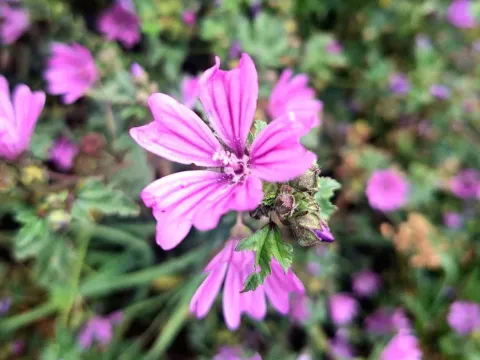
Mallow (genus Malva L.) belongs to the Malvaceae family and is an undemanding crop that can be sown both in autumn and spring. The optimal time for late-autumn sowing is October, which allows the seeds to undergo natural stratification.
7
items
What the section contains
Marketplace
Products in this section · 12


Mallow
Spring sowing is carried out as soon as the soil warms up to 8–10 degrees Celsius, usually in April or early May. It is important to ensure stable soil moisture, as the germination of mallow seeds depends heavily on the availability of moisture in the topsoil horizon.
For industrial cultivation, seeds are sown in rows spaced 45 to 60 centimeters apart to ensure sufficient nutrition area for each plant. The sowing depth varies from 2 to 3 centimeters depending on the soil type.
Mallow seedlings are sensitive to late spring frosts, so it is recommended to cover crops with agro-textile when sowing early. After the appearance of two or three true leaves, crops are thinned, leaving an optimal distance between individual plants in the row.
To speed up germination, seeds can be pre-soaked in warm water for a few hours. This stimulates their awakening and increases the percentage of field germination, which is critical for large-scale production.
Mallow prefers open, well-lit areas, as stems become elongated and weak in the shade. The crop is quite adaptable to various climatic conditions, but shows maximum productivity in regions with moderately warm summers.
Soil requirements for mallow are moderate: it grows best in fertile, light loams with good aeration. Water stagnation is unacceptable as it provokes root rot, so areas with high groundwater levels are unsuitable.
The crop responds positively to the application of organic fertilizers, such as humus or compost, during autumn soil preparation. Before sowing, it is also recommended to apply complex mineral fertilizers with a predominance of phosphorus and potassium.
Mallow has a developed root system, making it relatively drought-tolerant once mature. However, regular watering during the active growth and flowering phase significantly increases the biomass of the aerial part of the plant.
The optimal pH level for successful cultivation is in the range of 6.0–7.5. On highly acidic soils, the crop develops slowly and is more susceptible to infectious diseases, making liming a necessary agronomic practice.
Mallow yield depends on the purpose of cultivation — whether for green mass, medicinal flowers, or seed production. With proper agronomic practices, the yield of dry flower raw materials can reach 3–5 centners per hectare.
The biological productivity of the aerial mass when using the crop as green manure or feed supplement is significant, making it economically justified. Under intensive care, biomass yield increases several times over.
Factors influencing yield indicators include timely weed control, especially during the initial vegetation period. Mallow starts slowly, so competition control is critical for forming a high yield.
Regular harvesting of flowers, conducted multiple times throughout the season, stimulates the formation of new buds, which significantly extends the active plantation exploitation period. This allows for maximum yield per unit area.
An important indicator is seed quality, the purity of which depends on careful cleaning after threshing. The use of regionalized varieties guarantees stable yield indicators regardless of weather fluctuations.
The main threat to mallow is rust, a fungal disease that manifests as brown pustules on the underside of the leaf blade. Prevention includes crop rotation and fungicide treatment at the first signs of infection.
Powdery mildew also frequently affects crops, especially in high humidity and dense planting conditions. The disease manifests as a white coating, leading to premature leaf wilting and loss of raw material marketability.
Among pests, aphids are the most dangerous, as they suck juices from young shoots and buds, carrying viral diseases in the process. Biopreparations or systemic insecticides are used to control pest populations.
Spider mites can actively multiply in hot and dry summers, causing yellowing and leaf drop. Combating them requires regular inspections and timely application of acaricides according to safety regulations.
To reduce the risk of pests and diseases, it is important to remove plant residues after harvest and avoid monoculture on the same field for more than three years. Maintaining spatial isolation from other Malvaceae plants significantly lowers the infection background.
Harvesting mallow flowers is a labor-intensive process performed manually during the phase of full bud bloom. Flowers are picked daily or every other day, as they quickly lose their medicinal properties and appearance when overripe.
Raw material drying must be quick and carried out in the shade with good ventilation or in specialized dryers at temperatures not exceeding 40–45 degrees Celsius. Proper drying preserves the natural color of the petals, which is valued in pharmaceuticals.
Seed harvesting is carried out as the fruit-nutlets ripen and turn a characteristic brown shade. It is important not to miss the moment of seed capsule cracking to avoid harvest losses in the field.
Mallow green mass is harvested during the flowering phase if the plant is intended for use as a vitamin feed supplement. Mowers that ensure uniform stem chopping before ensiling or drying are used for this purpose.
Post-harvest processing includes cleaning seeds from impurities using grain cleaning machines. The finished product should be stored in dry, well-ventilated areas, protected from direct sunlight and high humidity.