
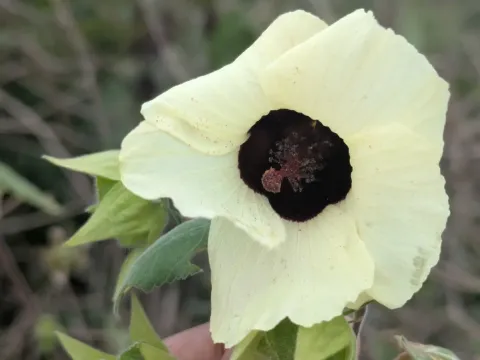
Hibiscus vitifolius
Hibiscus vitifolius
Sowing Hibiscus vitifolius requires well-warmed soil, as the plant is highly sensitive to cold and thrives only when frost risks are completely eliminated.
What the section contains
Hibiscus vitifolius
In tropical and subtropical zones, seeds are typically sown at the beginning of the rainy season to provide the necessary moisture for rapid germination and establishment.
Seeds should be placed at a depth of 1 to 2 centimeters to ensure they remain moist while allowing the seedlings to emerge efficiently through the soil surface.
Proper spacing between rows is essential to accommodate the plant's wide branching habit and to ensure that each plant receives adequate access to nutrients and light.
Pre-treatment of seeds, such as soaking in water for several hours, can significantly improve germination rates and synchronize the emergence of the stand.
Hibiscus vitifolius is a member of the Malvaceae family, characterized as a vigorous herbaceous shrub native to tropical regions across Africa, Asia, and Australia.
The crop demands full sunlight exposure for optimal growth; shaded environments typically result in weaker stems, which is counterproductive for fiber production.
It adapts well to a variety of soil types, but the highest yields are achieved on loamy, fertile, and well-drained soils that do not suffer from waterlogging.
A neutral to slightly acidic soil pH is ideal for the plant's nutrient uptake, ensuring healthy development of both the root system and the aerial parts.
While the plant shows moderate drought tolerance once established, regular irrigation during the peak growing season significantly enhances biomass accumulation.
The primary economic value of Hibiscus vitifolius lies in its bast fiber, which is known for its durability and utility in producing ropes, mats, and textiles.
The seeds of the plant contain oil that can be extracted for industrial purposes, adding secondary value to the crop's overall economic profile.
In various regions, the plant is also studied for its potential in the production of bio-composites and high-quality cellulose for the paper manufacturing industry.
Yield performance is highly dependent on nitrogen application during the vegetative stage, which promotes the growth of long, straight stems suitable for fiber extraction.
Successful commercial production relies on consistent plant density and effective field management to maximize the tonnage of harvestable stalks per hectare.
Aphids and spider mites are the most common pests that affect the plant, particularly in hot and dry climates where they can rapidly colonize leaf tissue.
Fungal diseases, including leaf spot and powdery mildew, often occur during periods of excessive humidity, requiring careful management of plant spacing to improve airflow.
Integrated pest management (IPM) strategies, including biological control and judicious use of pesticides, are essential to maintaining crop health without damaging the fiber quality.
Weed control is critical during the initial weeks after germination, as the plant is not a strong competitor in its early developmental stages.
Field sanitation, such as removing crop residues and rotating fields with non-Malvaceae crops, helps to disrupt the life cycles of common pests and pathogens.
Harvesting for fiber must take place during the full bloom stage to ensure the stems contain the ideal balance of fiber strength and flexibility.
Stalks are cut close to the ground, bundled, and then submerged in water tanks or slow-moving streams for retting to soften the non-fibrous tissues.
After retting, the fiber is carefully stripped from the woody core, washed thoroughly to remove impurities, and dried under moderate sun conditions.
Proper drying is essential to prevent mold growth and maintain the mechanical integrity of the fibers, which is crucial for textile-grade products.
Timely harvest ensures that the fiber does not become overly lignified, which would otherwise make it brittle and less valuable on the industrial market.