
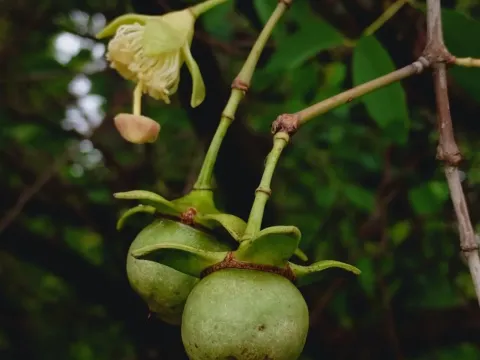
Sonneratia apetala
Sonneratia apetala
Propagation of Sonneratia apetala in natural and artificial environments is primarily carried out through seeds. The seeds possess high buoyancy, allowing them to disperse efficiently with tidal currents.
What the section contains
Sonneratia apetala
For establishing artificial plantations or forest restoration, seeds are sown in nurseries, preparing a substrate that accounts for high humidity levels. Germination occurs in muddy deposits provided there is regular saltwater flooding.
The optimal time for sowing or transplanting seedlings is linked to the onset of the rainy season, when salinity levels in estuaries decrease slightly, favoring the establishment of young plants.
During cultivation, it is crucial to maintain proper planting density, ensuring adequate light access and water circulation for the development of pneumatophores, or breathing roots.
Biological maturity for active growth is reached after the adaptation phase, which can last from several months to a year depending on the local hydrological regime.
Sonneratia apetala belongs to the Lythraceae family and is a characteristic plant of mangrove forests in South and Southeast Asia.
The culture requires specific conditions: zones with a tidal regime, characterized by regular cycles of flooding and drainage of the root system.
The soil for this crop must consist of soft alluvial or muddy deposits, rich in organic matter, with a neutral or slightly alkaline pH level.
The plant exhibits high tolerance to salinity and serves as an indicator of ecological health in coastal estuaries, requiring a consistently warm tropical climate without extreme temperature fluctuations.
The primary requirement is free access to aeration for pneumatophores, which allow the tree to obtain oxygen in the anaerobic conditions of the seabed sediment.
The economic use of Sonneratia apetala is focused not on fruit harvesting, but on securing ecological services and sustainable raw material resources.
The wood of this plant is utilized in local construction, as well as for crafting boats and tools, thanks to its high density and resistance to decay.
On an industrial scale, the species is valued as an effective barrier against coastline erosion, preventing the loss of fertile land and protecting inland regions from storm surges.
Leaves and young plant parts find application as fodder additives or as a source of biomass, which is evaluated in the context of integrated natural resource management.
Biomass yield depends on stand density; with proper forest management, ecosystem restoration indicators for this species surpass other mangroves in terms of growth rate.
The greatest threat to this culture is represented by anthropogenic factors: pollution of estuarine waters with oil products and heavy metals.
Typical pests include wood-boring insects and certain types of mollusks that damage the root system and bark of young trees, reducing their overall resilience.
Fungal diseases are more likely to occur when the natural hydrological cycle is disrupted, leading to stagnant water instead of natural tidal flushing.
Climate change, leading to excessive sea-level rise, can result in the flooding of the root system beyond tolerable limits, causing plantation degradation.
Competition from invasive species can suppress the growth of Sonneratia apetala, therefore, technical control includes periodic clearing of sites from invasive vegetation.