
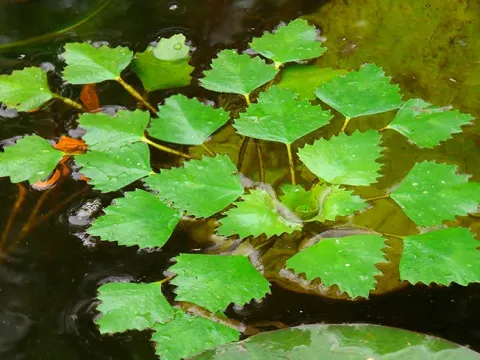
Water caltrop
Trapa
Sowing of Trapa seeds occurs in spring when the water temperature in the reservoir reaches a stable 15–20 degrees Celsius. To ensure successful germination, nuts that have overwintered in the silt naturally rise to the surface, so it is important to keep the reservoir free from excessive algae.
What the section contains


Water caltrop
For commercial purposes, sowing is performed directly into the bottom substrate at a depth of 5–10 centimeters. It is optimal to use areas with slow currents or stagnant water, as strong water movement prevents the young shoots from rooting properly.
Seeds retain viability only in an aquatic environment; therefore, it is critical to keep the planting material moist during storage. Desiccation even for a short period leads to total loss of embryonic viability.
Planting density is calculated based on the water surface area. It is recommended to leave open space between groups of plants to ensure adequate gas exchange within the water column and sufficient solar access.
The plant is an annual, meaning the cycle of population renewal each season depends on the quality of seed deposition on the reservoir floor in the previous period. Managing population density is essential to prevent excessive overgrowth of the water area.
Trapa belongs to the Lythraceae family, although it was formerly classified in the separate Trapaceae family. This aquatic plant prefers sunny, well-warmed areas of reservoirs with silty or clayey bottoms.
The crop is extremely sensitive to water clarity. Excess organic fertilizers washing off from agricultural fields into reservoirs can trigger algal blooms, which inhibit water caltrop development and reduce overall yield.
The optimal depth for full growth and development ranges from 0.5 to 2 meters. If the depth is too great, the plant becomes leggy, while at insufficient depths, it risks damage from ice or mechanical objects.
A key requirement is the absence of severe chemical pollution, as the plant actively accumulates minerals from the water. In low-flow lakes and ponds, it forms dense leaf rosettes held at the surface by inflated petioles.
Temperature regime plays a vital role: stable warm weather during the summer is necessary for active photosynthesis and nut formation. Sudden cold snaps mid-season can significantly delay the ripening of the nuts.
The yield of Trapa is determined by the number of rosettes per square meter of water surface. Under favorable conditions, one hectare can produce between 500 and 1500 kilograms of processed, cleaned nuts.
The fruits are drupes with a hard shell, equipped with characteristic horn-like protrusions. The mass of a single nut varies, but on average, one plant can produce from 10 to 20 mature seeds.
Yield stability depends on the absence of pests during the flowering period. Flowering begins in June, and nut ripening concludes by late August or early September, depending on the climatic zone.
Crop productivity increases in silt rich in organic matter. However, excessive proliferation leads to overcrowding, where the number of nuts per individual plant drops due to competition for light and nutrients.
Economic efficiency is achieved through integrated water use, where Trapa is grown as a secondary crop that requires no fertilization or expensive pesticide treatments.
The main threat to water caltrop plantations is waterfowl, which actively consume both young shoots and ripening nuts. This can lead to significant crop losses in shallow areas.
Biological diseases such as leaf rust or fungal infections are less common but can appear under high planting densities and stagnant water conditions. Protection is difficult in such cases due to the inability to use chemicals in water bodies.
Insect pests specific to Trapa include certain leaf beetles capable of damaging leaf blades. However, massive outbreaks of insect populations are rare when natural predators are present in the ecosystem.
The main anthropogenic factor is the eutrophication of reservoirs. Changes in water acidity or critical drops in dissolved oxygen levels due to decaying organic matter lead to the death of the Trapa root system.
Uncontrolled overgrowth of the reservoir by other species (such as reeds or cattails) displaces Trapa because it is extremely photophilous. Mechanical cleaning of the water area is a necessary part of the agronomy.
Harvesting of Trapa is conducted manually or using small boats after the fruits have fully matured. The nuts either float on the surface or sink to the bottom when the parent plant decays.
The ideal time for harvesting is August and September. Nuts are considered ready for collection when their shell turns a dark, almost black color, and the horns become hard and rigid.
After collection, the fruits require immediate primary processing. They are washed to remove silt, cleaned of debris, and dried in the shade to prevent mold on the kernel.
In culinary and industrial applications, the nut is used after removing the hard shell. The kernel contains significant amounts of starch, proteins, and trace elements, making it a valuable food product.
Storage of the harvested crop is carried out in a cool, ventilated room. It is important to avoid overheating, as the high moisture content of the fresh product promotes rapid spoilage if temperature conditions are ignored.