
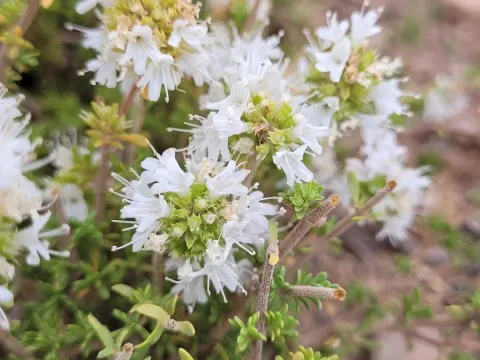
Thymus saturejoides
Thymus saturejoides
Sowing of Thymus saturejoides should be carried out in spring when soil temperatures reach 15-18°C. Because the seeds are extremely small, they should be sown on the surface and lightly covered with a thin layer of substrate or sand to ensure exposure to light, which is crucial for germination.
What the section contains
Thymus saturejoides
In commercial operations, the transplanting method is often preferred to ensure uniform stand establishment and better survival rates. Seedlings are transplanted into the field in late spring, spacing them about 25-30 cm apart to allow for proper air circulation and plant development.
As a perennial crop, selecting the right site is vital. Thymus saturejoides thrives in sunny, well-drained locations protected from strong winds, as abundant sunlight is necessary for the maximum accumulation of essential oils in the foliage.
For direct sowing, the soil must be prepared thoroughly to eliminate perennial weeds and create a smooth seedbed. Lightly rolling the soil after sowing improves seed-to-soil contact, which significantly boosts germination rates in field conditions.
In regions with mild winters, autumn sowing can be performed to allow for natural stratification, leading to earlier spring growth. This practice maximizes the growing season, allowing plants to establish deep roots before the heat of summer.
Thymus saturejoides is a perennial semi-shrub belonging to the Lamiaceae family. Its natural distribution is primarily in the mountainous regions of North Africa, particularly Morocco, where it has adapted to semi-arid environments.
The plant prefers light, well-drained, calcareous soils with a neutral to slightly alkaline pH. Heavy clay soils that retain moisture are detrimental, as they often lead to root rot and decrease the overall plant vitality.
This crop is highly drought-tolerant, making it suitable for cultivation on poor soils or slopes. However, during the first few years, supplementary irrigation during extreme drought periods is recommended to ensure strong initial growth and yield.
Monitoring soil acidity is essential, as the species does not tolerate acidic substrates. Balanced fertilization with potassium helps strengthen the plant tissues and increases the concentration of valuable bioactive compounds.
Botanically, it is a low-growing subshrub with woody stems and small, leathery leaves. During summer, the plant produces distinctive inflorescences that carry a unique aroma reminiscent of both savory and thyme, reflecting its taxonomic name.
The yield of green biomass depends on planting density and the level of agronomic management. Under intensive cultivation, a mature plantation can produce 3 to 6 tonnes of dry matter per hectare, depending on site quality and age.
Peak productivity is typically reached in the second and third years after planting. Harvesting is conducted during the full bloom phase, which corresponds to the highest concentration of essential oils in the foliage and flowers.
Quality management is critical after harvest. The plant material should be dried at temperatures not exceeding 40°C to preserve the volatile aromatic components that define its commercial and medicinal value.
Processing involves cleaning the raw material to remove impurities and milling the dried herb to specific requirements. The quality is primarily assessed by the content of thymol and carvacrol, the main active ingredients.
Economic profitability is driven by the consistent demand for its medicinal and culinary properties. Regular pruning after flowering encourages the growth of lateral shoots, which helps to sustain yields over several seasons.
Fungal diseases are the primary threat to the crop, especially in conditions of high humidity. Powdery mildew can appear as a white coating on the leaves and requires prompt treatment with biological fungicides to prevent spread.
Root rot occurs most frequently when drainage is insufficient or when the soil remains waterlogged. Preventing these conditions through proper land preparation and crop rotation is the most effective management strategy.
Pests like aphids and spider mites may occasionally infest the plantation. In such cases, the use of biological control agents or targeted, herb-safe treatments is recommended to maintain the organic integrity of the crop.
Soil-borne pests such as wireworms can damage the root systems of young plants. Deep cultivation between rows helps disrupt their life cycles and reduces the likelihood of significant damage to the root zone.
Generally, the crop is robust when grown in suitable conditions. Maintaining proper plant spacing is key to ensuring good airflow, which significantly reduces the risk of moisture-related infections throughout the growing season.
Harvesting Thymus saturejoides is usually mechanized using specialized sickle-bar mowers. The plants are cut at a height of 10-15 cm, leaving the lower woody frame intact to facilitate rapid regrowth and recovery.
Timing the harvest to the peak flowering phase is essential for capturing the best aromatic profile. This window ensures the highest levels of active ingredients required by the pharmaceutical and essential oil industries.
Speed is critical after harvest; the material must be transported to the drying facility immediately. Allowing cut material to sit in piles can lead to heating and fermentation, which destroys the product quality.
During transport, it is vital to protect the biomass from direct sunlight, which can rapidly degrade aromatic compounds. Using mesh crates or bags ensures adequate ventilation and maintains the freshness of the harvested material.
Depending on the climatic zone, it is possible to achieve two harvests per year. A second cutting can be performed in late summer, provided there is enough soil moisture for the plants to recover before the onset of winter.