
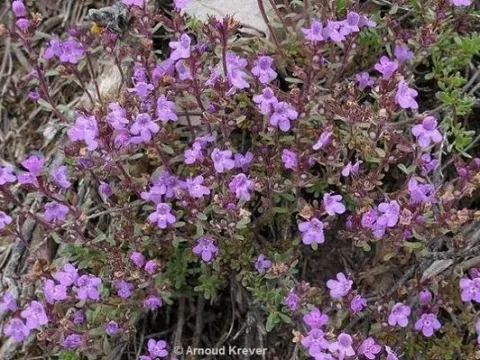
Thymus mastigophorus
Thymus mastigophorus
Thymus mastigophorus is a perennial subshrub belonging to the Lamiaceae family. Commercial cultivation typically involves seedling propagation in greenhouses to ensure high survival rates and uniform plant development before field transplanting.
What the section contains
Thymus mastigophorus
Seeds are sown in late winter or early spring in a well-draining substrate. Given their small size, seeds require minimal covering with soil to ensure sufficient light exposure for germination, which generally occurs within 14 to 21 days.
Transplanting into the open field should be scheduled after the risk of late spring frosts has passed. The planting density is typically maintained at 5 to 7 plants per square meter to allow for optimal airflow and prevent competition for nutrients.
Vegetative propagation via cuttings is a common practice for industrial plantations to maintain genetic uniformity. Cuttings are taken during the active growth phase and rooted in sand-based media under controlled humidity.
Preparation of the field involves thorough weeding and soil leveling. Proper spatial planning during the sowing or planting phase is essential for mechanical maintenance and future harvest efficiency.
This species is highly adapted to sunny environments and requires full exposure to sunlight for at least 6 to 8 hours daily. Insufficient light leads to etiolated growth and reduced concentration of essential oils, significantly lowering the market value of the crop.
The ideal soil for Thymus mastigophorus is a sandy, well-draining loam with a neutral or slightly alkaline pH. Poor drainage is the most significant limiting factor, as the roots are highly susceptible to rot if waterlogged for extended periods.
Although the plant is drought-tolerant once established, supplemental irrigation is necessary during the early stages of growth and during prolonged heatwaves to sustain biomass production and essential oil synthesis.
Soil fertility requirements are moderate. Excessive nitrogen application promotes vegetative growth at the expense of oil quality, so balanced fertilization focusing on phosphorus and potassium is preferred for optimal yield.
The plant demonstrates good tolerance to moderate temperature fluctuations, but protecting the crops from cold, drying winds is recommended in cooler regions to prevent winter dieback and damage to the evergreen foliage.
The yield of Thymus mastigophorus is heavily influenced by the age of the plantation and the frequency of harvests. Under optimal management, the plantation can produce a high-quality yield for approximately 5 to 7 years.
Average annual yields vary depending on local climatic conditions, but intensive cultivation can yield several tons of fresh biomass per hectare per season, typically split across one or two cutting cycles.
The concentration of essential oils reaches its peak at the 3rd and 4th years of the plant's life. Growers should optimize the harvest time to align with these biological maturity milestones to maximize profitability.
Mechanical weed control and regular pruning are essential to maintain high yield levels over the long term. Neglected fields often show significant declines in productivity due to nutrient depletion and increased competition.
Strategic irrigation and fertilization programs can enhance yield, but they must be calibrated carefully to avoid inducing excessive succulent growth, which can make the plants more vulnerable to winter damage.
Root rot caused by pathogens such as Phytophthora and Fusarium represents a primary threat, especially in soils with inadequate drainage or compaction. Prevention involves careful water management and field site selection.
Pests like aphids and certain species of weevils can cause significant damage to young shoots and flowers. Integrated Pest Management (IPM) strategies, including the use of beneficial insects, are encouraged to protect the crop.
Powdery mildew is a common fungal disease that affects plants in conditions of high humidity and poor ventilation. Keeping rows well-spaced and ensuring adequate air movement is the most effective preventative measure.
Nematode infestations can lead to stunted growth and yellowing of the leaves. Crop rotation is a vital strategy, as the plant should not be grown on the same plot for more than five consecutive years to avoid buildup.
Early identification of pest or disease symptoms is crucial for effective intervention. Regular field monitoring and the removal of infected plant parts help contain outbreaks and protect the overall health of the plantation.
Harvesting is typically conducted during the mid-bloom stage, when the essential oil content is at its highest. It is vital to perform this task during dry weather to facilitate rapid drying and prevent microbial growth.
The plants are mown or cut at a height of 10-15 cm above the soil surface. This height ensures that the plant retains enough woody structure to regenerate quickly for a second harvest or the following season.
Post-harvest management is critical; fresh material should be transported immediately to drying facilities. Stacking fresh herbs in large piles must be avoided to prevent overheating and the subsequent loss of volatile compounds.
Drying is performed in climate-controlled areas with good ventilation. Temperatures must remain below 35 degrees Celsius to preserve the chemical profile and therapeutic properties of the oil components.
Once dried, the product is processed and packaged in light-protected, airtight containers. Proper storage conditions ensure the longevity of the product and maintain the high standards required by the pharmaceutical and culinary industries.