
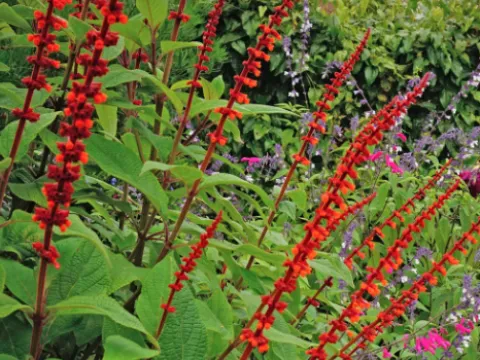
Red velvet sage
Salvia confertiflora
Salvia confertiflora, commonly known as red velvet sage, is a distinctive member of the Lamiaceae family. It is typically propagated via seeds sown in greenhouse conditions during late winter or early spring.
What the section contains
Red velvet sage
The seeds require a light, well-draining potting medium and should be covered very lightly, as they need some light to germinate effectively.
Maintaining a constant soil temperature between 20 and 22 degrees Celsius ensures a uniform germination process that usually spans up to three weeks.
Vegetative propagation using stem cuttings is highly favored by growers to maintain consistent characteristics and shorten the production cycle for greenhouse or garden use.
Young plants should be hardened off before being transplanted into their final location, ensuring all danger of frost has definitively passed in the spring season.
This species thrives in warm climates and requires a sunny exposure to produce its characteristic dense, red-orange flower spikes.
The soil should be fertile, organic-rich, and well-aerated; Salvia confertiflora is particularly intolerant of heavy, waterlogged soils that induce root decay.
Regular irrigation is essential during the active growing season, though the plant shows moderate drought tolerance once established in the ground.
For optimal development, gardeners should apply a balanced fertilizer throughout the growing season, focusing on promoting both vegetative growth and floral production.
As a tender perennial, it is often treated as an annual in cooler regions or maintained in containers that are moved to a frost-free environment for the winter.
Root pathogens such as Pythium and Phytophthora are the primary threats, especially in poorly drained soils or conditions with excessive moisture.
Pests like aphids and whiteflies frequently infest the soft foliage and terminal buds, potentially transmitting viral diseases to the crop.
Spider mites are a common nuisance during hot and dry summer spells, causing chlorosis and fine webbing on the undersides of the leaves.
Powdery mildew is a significant fungal issue that arises when air circulation is poor, necessitating adequate spacing between individual plants.
Integrated pest management, including regular monitoring and the use of targeted biological controls, is highly recommended to keep these plants healthy.