
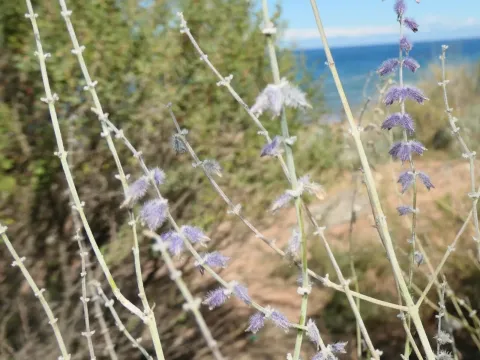
Salvia abrotanoides
Salvia abrotanoides
Sowing of Salvia abrotanoides is typically carried out in the spring when soil temperatures reach 10–12 degrees Celsius. It is essential to select a planting window after the last frost, as young seedlings are sensitive to low temperatures.
What the section contains
Salvia abrotanoides
Propagation is achieved through either seeds or vegetative methods, such as root division or cuttings. When sowing seeds, the planting depth should not exceed 1–1.5 centimeters to ensure uniform germination.
On a commercial scale, seeds are sown in rows with spacing of 60–70 centimeters. This layout allows for the mechanization of field maintenance and ensures adequate sunlight for every plant.
Pre-sowing seed treatment involves stratification for 2–3 weeks to increase germination rates. Additionally, soaking seeds in growth stimulants prior to planting in open ground is highly recommended.
The optimal plant density ranges from 40,000 to 60,000 plants per hectare. This density provides an ideal balance between root development and the production of aerial biomass.
Salvia abrotanoides is a sun-loving plant that thrives best in open, sunny fields. Excessive shading during the growth phase leads to a significant decrease in essential oil concentrations within the leaves.
The crop prefers light, well-drained sandy or loamy soils with a neutral to slightly alkaline pH level. Heavy clay soils with poor drainage are detrimental to the health of its root system.
The plant demonstrates high drought resistance, a trait derived from its botanical origins in arid regions. It can endure long periods without precipitation without significant harm to its vegetative development.
The optimal temperature range for active growth is between 20 and 25 degrees Celsius. During the spring warming period, the plant shows excellent adaptability to diurnal temperature fluctuations.
Fertilizer application should be moderate, focusing primarily on phosphorus-potassium complexes. Excessive nitrogen encourages rapid foliage growth at the expense of secondary metabolite synthesis.
Harvesting is conducted during the mass flowering stage, which is when essential oil content reaches its biological peak. Usually, this timing falls in the middle or late summer.
The raw material is harvested by mowing the aerial parts of the plant at a height of 10–15 centimeters above the ground. This practice facilitates quick regrowth for the subsequent season.
The cut plant material must be dried immediately in shaded, well-ventilated areas or in specialized drying units at temperatures not exceeding 40 degrees Celsius.
To preserve the quality of the essential oils, it is crucial to avoid exposure to direct sunlight during the drying process. High-quality dry material should maintain its natural color and distinct aroma.
- Adherence to harvest timing is critical for extract quality.
- Specialized harvesting equipment for medicinal herbs is recommended.
- Proper storage conditions extend the shelf life of the dried product up to 2 years.