
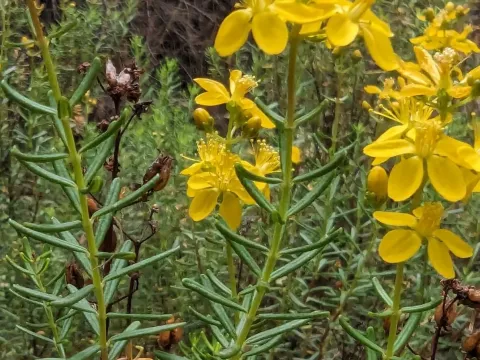
Crowberry-leaved St. John's wort
Hypericum empetrifolium
Crowberry-leaved St. John's wort (Hypericum empetrifolium) is a perennial evergreen subshrub belonging to the Hypericaceae family. It is native to the Eastern Mediterranean, particularly prevalent in Greece and the Aegean islands.
What the section contains
Crowberry-leaved St. John's wort
The plant is distinguished by its unique morphology; it features small, narrow, scale-like leaves that are pressed against the stem, an evolutionary adaptation to arid conditions and intense sunlight. It typically forms a dense, compact shrub habit.
The species thrives in well-drained, rocky, or limestone-rich soils. Proper aeration of the root zone is crucial, as the plant is highly susceptible to root rot and fungal issues if kept in waterlogged or heavy, poorly draining soil conditions.
It requires full sun exposure to flourish. While it is hardy in Mediterranean climates, it lacks significant frost tolerance, necessitating protective measures or greenhouse cultivation in colder temperate regions to ensure plant survival.
Agrotechnical management is relatively low-intensity. It requires minimal fertilization, as high nutrient levels can disrupt the concentration of essential metabolites, and irrigation should be provided sparingly only during extreme drought.
The primary utility of Hypericum empetrifolium lies in its pharmaceutical and aromatic properties, specifically the accumulation of essential oils and specialized secondary metabolites within its foliage and flowers.
Harvesting should occur during the peak flowering stage. Harvesters typically prune the aerial parts of the shrub, ensuring that enough vegetative biomass remains to allow the plant to recover and photosynthesize for the following season.
The harvested material must be dried promptly using controlled thermal conditions. Keeping the drying temperature low is essential to preserve the volatile organic compounds that constitute the value of this crop.
Proper storage is the final step in the cycle. The dried herb should be kept in airtight containers away from direct light to prevent the oxidation of active ingredients and to ensure the product remains viable for industrial processing.
Regular monitoring of plant health during the pre-harvest period is vital to ensure that the material is free from pest damage or pathogens, which could otherwise compromise the chemical profile of the final extract.