
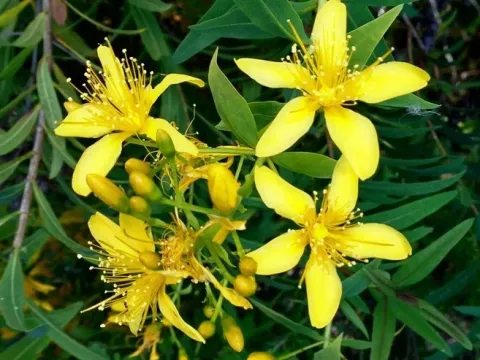
Canary Islands St. John's wort
Hypericum floribundum
Hypericum floribundum, commonly known as the Canary Islands St. John's wort, is an evergreen shrub belonging to the Hypericaceae family. It is a distinctive species native to the high-altitude regions of the Canary Islands, where it thrives in specific volcanic soils.
What the section contains
Canary Islands St. John's wort
The crop requires full sun exposure to maintain its vigorous growth pattern and to ensure the proper development of secondary metabolites. In an agricultural setting, site selection is crucial to provide maximum solar radiation throughout the growing season.
Soil requirements for this species are quite strict regarding drainage. It performs best in well-draining, rocky, or sandy loam soils. It is highly intolerant of waterlogged conditions, which can quickly lead to root decay.
As a sub-tropical species, it prefers mild temperatures and has limited frost tolerance. When cultivated in temperate zones, greenhouse conditions or winter protection are often necessary to ensure the survival of the plants.
Fertilization should be handled with care, as native species of this genus are accustomed to nutrient-poor soils. Over-fertilization, especially with nitrogen, can lead to succulent growth that is more prone to pest attacks and disease.
The main threats to Hypericum floribundum include various fungal pathogens that thrive in high humidity. Rust and powdery mildew are frequently reported, requiring careful humidity control and air circulation strategies.
Pests such as aphids and spider mites are common in greenhouses and open fields during dry periods. These pests can rapidly multiply on the tender terminal shoots, causing stunted plant growth and reduced leaf quality.
Root rot, typically caused by species of Pythium or Phytophthora, represents a critical threat. Ensuring that the planting beds have a significant slope or gravel layer for drainage is the most effective preventative measure.
Integrated pest management (IPM) is highly recommended. This involves the use of predatory insects to control aphid populations and the strategic application of fungicides only when necessary to preserve plant health.
Regular field inspections and the removal of fallen debris are essential practices. Maintaining a clean cultivation environment significantly reduces the inoculum levels of pathogens that could otherwise wipe out the crop.