
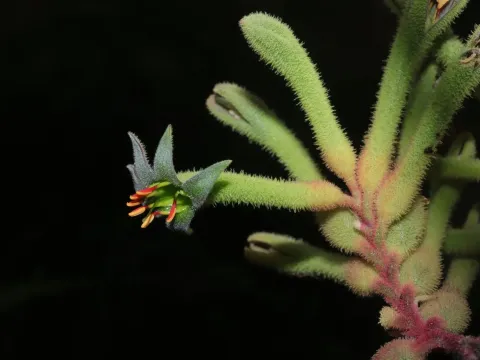
Kangaroo paw
Anigozanthos Labill.
Kangaroo paw is primarily propagated from seed, although it can be grown via division. Seeds should be sown in late winter or early spring in a light, well-draining seed-starting mix enriched with sand.
What the section contains
 Albany Catspaw
Anigozanthos preissii Endl.
Albany Catspaw
Anigozanthos preissii Endl.
 Anigozanthos bicolor
 Endl.
Anigozanthos bicolor hybrid
Anigozanthos bicolor x Anigozanthos humilis
Anigozanthos bicolor
Anigozanthos bicolor Endl.
Anigozanthos bicolor hybrid
Anigozanthos bicolor x Anigozanthos humilis
 Anigozanthos humilis
 Lindl.
Anigozanthos humilis
Anigozanthos humilis Lindl.
 Anigozanthos hybrid
Anigozanthos viridis x Anigozanthos manglesii
Anigozanthos hybrid
Anigozanthos viridis x Anigozanthos manglesii
 Anigozanthos pulcherrimus
 Hook.
Anigozanthos pulcherrimus
Anigozanthos pulcherrimus Hook.
 Anigozanthos rufus
 Labill.
Green kangaroo paw
Anigozanthos viridis Endl.
Anigozanthos rufus
Anigozanthos rufus Labill.
Green kangaroo paw
Anigozanthos viridis Endl.
 Kangaroo paw
Anigozanthos flavidus DC.
Kangaroo paw
Anigozanthos flavidus DC.
 Mangles' Kangaroo-paw
Anigozanthos manglesii D. Don
Mangles' Kangaroo-paw
Anigozanthos manglesii D. Don
Kangaroo paw
Successful germination requires a stable temperature range between 20 and 25 degrees Celsius. Pre-soaking seeds or using growth stimulants can significantly improve the speed and uniformity of germination.
Once seedlings develop their first true leaves, they should be carefully pricked out into individual pots. Minimizing root disturbance during this process is crucial for the health of the young plant.
Commercial producers often use climate-controlled greenhouses with supplemental lighting to ensure year-round growth. Proper ventilation during the seedling stage is essential to prevent damp-off diseases.
Plants should only be moved to their final growing location once all danger of frost has passed, as the species is highly intolerant of cold temperatures and freezing conditions.
The Kangaroo paw belongs to the Haemodoraceae family and is native to Australia. In its natural habitat, it thrives in nutrient-poor, sandy soils that experience seasonal dry periods.
The plant demands high levels of sunlight for optimal flowering. Low light conditions often lead to weak, elongated stems and dull-colored inflorescences that lose their characteristic beauty.
Excellent soil drainage is the single most important factor for success. The plant is prone to root rot if the substrate stays waterlogged for even short periods of time.
Watering should be moderate, allowing the top layer of the substrate to dry out between applications. After the flowering period ends, the plant enters a dormant phase and needs much less water.
Proper airflow is essential to keep the plant healthy. High humidity combined with stagnant air often invites fungal infections, which are the main health risks for this culture.
Rust disease is the most common threat, manifesting as dark, dusty spots on the foliage and flower stalks. Regular fungicide applications are necessary in humid or poorly ventilated conditions.
Root rot is typically caused by overwatering or using heavy, non-porous soil mixes. Once a plant is affected, it is often difficult to save, making prevention the best strategy.
In greenhouse settings, pests such as aphids and spider mites can infest the plants. Integrated pest management, including systemic insecticides, should be used as soon as the first signs appear.
Snails and slugs can damage young, tender foliage when grown outdoors. Protective barriers or bait stations are recommended for vulnerable plantings in damp climates.
While viral infections are rare, they are irreversible. Any plant showing symptoms of mosaic or leaf curling should be removed and destroyed to prevent spread to healthy specimens.
Anigozanthos is grown commercially as a specialty cut flower. Harvesting occurs when approximately 50% of the florets on the inflorescence have fully opened.
Cuts should be performed early in the morning or late in the evening. It is vital to use clean, sharp shears to minimize physical damage to the plant and prevent pathogen entry.
The flowers have an excellent vase life, often remaining attractive for two weeks or longer. They are also highly valued for use in dried flower arrangements due to their unique texture.
After harvesting the blooms, the spent stalks should be cut back to the base of the leaf rosette. This promotes healthy vegetative recovery and prepares the plant for future bloom cycles.
During transport, cut stems should be handled carefully to avoid damaging the velvety hairs on the flowers, which are a defining aesthetic feature of the Kangaroo paw.