
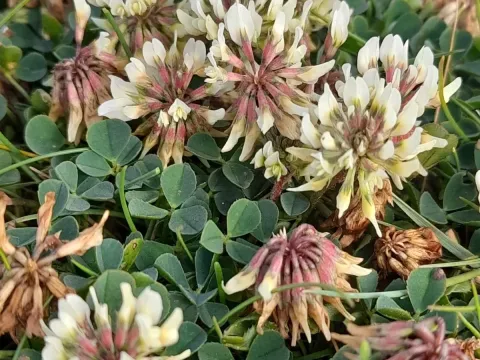
Western clover
Trifolium occidentale
Western clover is a perennial legume species primarily valued in forage production systems. The optimal sowing time is during early spring or late summer, capitalizing on moderate temperatures and sufficient soil moisture to ensure successful seed germination and rapid establishment of the root system.
What the section contains
Western clover
A finely tilled and firm seedbed is essential for this species. Seeds should be sown at a shallow depth of approximately 1 to 2 centimeters to provide the necessary contact with soil particles while allowing sufficient light penetration to trigger the germination process.
In many agricultural settings, Western clover is sown as an undercrop beneath cereal grains. This practice provides a protective microclimate for the developing seedlings, shielding them from intense sunlight and helping to regulate soil moisture levels during the critical initial growth phase.
Adhering to recommended seeding rates is vital for maintaining an optimal stand density. Excessive density can lead to nutrient competition and poor air circulation within the canopy, which significantly increases the susceptibility of the crop to various fungal pathogens.
Post-sowing compaction using a roller is a critical step in the establishment process. This action minimizes air pockets in the soil and promotes efficient moisture movement towards the seeds, which is necessary for uniform emergence across the entire field area.
Trifolium occidentale is naturally adapted to temperate maritime climates. Its evolutionary origin in coastal regions makes it highly resistant to salt spray and high winds, allowing it to thrive in environments where many other legumes might struggle to survive.
The species performs best in well-drained soils that prevent waterlogging. It is highly sensitive to excessive soil moisture, which can lead to root rot and other physiological stresses that hinder growth and significantly reduce biomass yield during the growing season.
Western clover requires neutral to slightly alkaline soil conditions to reach its full productive potential. In areas with acidic soil profiles, liming is recommended to improve the conditions for beneficial rhizobia bacteria, which are responsible for nitrogen fixation.
As a light-demanding crop, it should be cultivated in open areas that receive full solar radiation. Shade negatively affects the photosynthetic efficiency of the plant, resulting in reduced vigor, thinner stems, and a lower overall accumulation of protein in the harvested forage.
The temperature range should remain moderate during the active growth periods. Western clover is sensitive to extreme heat and prolonged droughts, necessitating supplemental irrigation in drier climates to maintain the metabolic processes required for consistent biomass production.
The biomass yield of Western clover depends heavily on the intensity of management and the fertility of the site. With proper nutrient inputs, specifically phosphorus and potassium, the crop is capable of producing multiple high-quality cuts within a single growing season.
Management of the grazing or cutting frequency is key to long-term productivity. Frequent harvesting must be balanced with adequate recovery periods to prevent the depletion of carbohydrate reserves in the roots, which are essential for the plant's overwintering and regrowth.
The biological ability of this species to form a dense canopy allows for rapid soil coverage and protection, contributing to stable yields. In intensive production systems, it is often utilized in mixture with grasses to enhance overall dry matter output and nutritional quality.
Productivity typically peaks during the second and third years of the stand. By this stage, the root system is fully developed, and the plants are better equipped to handle environmental fluctuations, resulting in more stable forage supply for livestock operations.
In addition to biomass, Western clover contributes significantly to soil health through nitrogen fixation. This natural input reduces the need for synthetic nitrogen fertilizers, making it an economically and ecologically advantageous component of sustainable crop rotations.
Fungal diseases such as powdery mildew, anthracnose, and various leaf spot complexes pose the most significant threat to crop health. These pathogens are most prevalent under conditions of high humidity and poor stand ventilation, requiring diligent field monitoring.
Pests, particularly clover weevils and aphids, can cause substantial damage to both vegetative tissue and reproductive organs. Infestations during the flowering stage are particularly detrimental as they directly impact seed yield and decrease the vigor of the plant for the following season.
Nematode infestations represent an underground threat that often goes unnoticed until visible symptoms like yellowing, stunted growth, and premature wilting appear. Crop rotation is the most effective strategy for mitigating the risk of nematode buildup in the soil.
Preventive measures include the use of certified, disease-free seed and maintaining a consistent crop rotation interval of at least four to five years. Avoiding the reuse of land for clover production in quick succession is crucial for breaking the infection cycles of soil-borne pathogens.
Integrated pest management protocols should prioritize the use of resistant varieties and biological controls when possible. Chemical interventions should only be implemented when pest pressure exceeds economic thresholds, strictly adhering to safety intervals to ensure forage quality.
The timing of the harvest is the most critical factor influencing the nutritional value of the forage. Harvesting should occur at the onset of the flowering stage to capture the highest concentrations of crude protein, minerals, and digestible carbohydrates within the plant tissue.
Equipment setup is paramount to success; mowers must be calibrated to a cutting height of 5 to 7 centimeters. This height ensures that the basal portion of the stem and the apical meristems remain intact, allowing for vigorous regrowth after the harvest event.
Post-harvest management involves timely wilting of the swath to achieve the correct moisture content. The use of tedders helps accelerate moisture loss, reducing the risk of respiratory losses and ensuring the preservation of the nutritional integrity of the hay or silage.
Proper storage is essential to maintain feed quality throughout the winter months. Whether stored as dry hay or ensiled in high-density bales, protection from moisture and direct sunlight is necessary to prevent spoilage, mold growth, and the development of toxins.
When harvesting for seed production, the crop should be gathered once the seed heads have turned brown and reached physiological maturity. This ensures maximum seed fill and viability, which are essential for maintaining the productivity of future plantings in the field.