
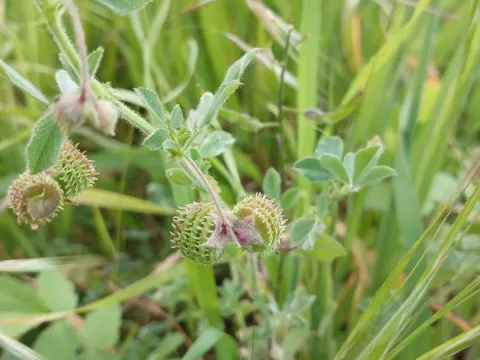
Wheel medic
Medicago rotata
The wheel medic (Medicago rotata) is an annual legume belonging to the Fabaceae family. It is typically sown in early spring as soon as soil temperatures reach a consistent 8–10 degrees Celsius.
What the section contains
Wheel medic
Early sowing allows the crop to utilize residual soil moisture, which is essential for rapid germination and establishment. Depending on the latitude, the planting window usually spans from late March through April.
Standard seeding methods involve row spacing of about 15 cm. This configuration helps the crop establish a canopy quickly, which suppresses weed competition effectively during the initial growth stages.
Seeds should be placed at a depth of 2 to 3 cm. Proper depth control is critical because the seeds are relatively small and will fail to emerge if planted too deep or left on the dry surface.
Seedbed preparation should involve firming the soil to ensure good seed-to-soil contact. A level field surface is necessary for uniform germination and ease of management during the growth cycle.
Originating from the Mediterranean region, this species is highly adapted to arid and semi-arid climates. It exhibits significant drought tolerance, making it suitable for areas with limited summer rainfall.
It performs best in well-drained, fertile soils with a neutral or slightly alkaline pH. Soils prone to waterlogging or high acidity are generally unsuitable and will significantly reduce biomass production.
Full solar exposure is a fundamental requirement for Medicago rotata. Reduced light levels, whether from weeds or dense planting, result in spindly stems and diminished nitrogen-fixing capacity.
Mineral nutrition should focus on phosphorus and potassium to encourage robust root development. As a legume, it benefits from the presence of symbiotic Rhizobium bacteria in the soil to fix atmospheric nitrogen.
While tolerant of heat, the crop performs best under moderate temperatures. In very hot conditions, moisture availability in the subsoil becomes the limiting factor for sustained growth.
Key insect threats include the alfalfa weevil and various species of aphids that feed on the foliage. These pests can drastically reduce photosynthetic area if left untreated.
Fungal diseases like powdery mildew and various leaf spots are more prevalent during periods of high humidity. Proper crop rotation helps break the cycle of soil-borne pathogens.
Weed management is most critical during the first 30 days after emergence. Mechanical weeding or selective herbicide application should be timed to minimize competition for nutrients and water.
Rodents can cause damage to the taproot, particularly in dormant or low-growth periods. Regular field scouting is necessary to identify early signs of infestation.
Effective Integrated Pest Management (IPM) strategies should be prioritized, utilizing threshold-based interventions to protect the crop while minimizing environmental impact on beneficial insects.