
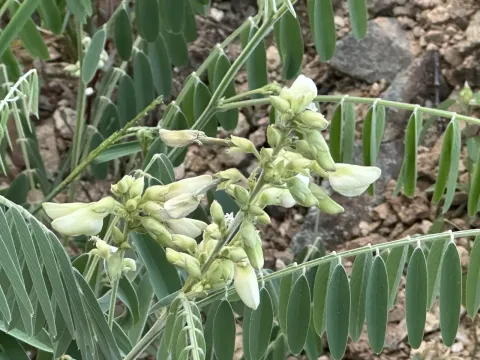
Tephrosia sinapou
Tephrosia sinapou
Sowing Tephrosia sinapou is optimally timed at the beginning of the rainy season to ensure adequate moisture levels for seed germination and initial root development.
What the section contains
Tephrosia sinapou
Seeds often benefit from scarification before planting to break physical dormancy, which significantly improves the uniformity of plant emergence in the field.
The seeds should be planted at a depth of 2 to 3 centimeters, ensuring sufficient soil contact without being buried too deeply for the sprout to reach the surface.
The seeding rate should be calibrated based on the intended use, such as biomass production or erosion control on slopes where higher densities are often preferred.
Once established, the plants grow rapidly, making them highly effective at suppressing weeds in their immediate vicinity during the early growth stages.
Tephrosia sinapou is a perennial legume species that thrives in tropical climates and is well-adapted to high-temperature environments.
It displays remarkable versatility regarding soil types, performing well on nutrient-poor soils due to its inherent ability to fix atmospheric nitrogen via rhizobia.
The plant requires full exposure to sunlight for maximum biomass accumulation; while it tolerates some degree of shade, growth rates drop in shaded areas.
Well-drained soil is a strict requirement for this crop, as waterlogging is detrimental to both the plant's health and its nitrogen-fixing bacteria symbiosis.
It prefers soil pH levels ranging from slightly acidic to neutral, which matches the conditions prevalent in its native tropical geographical range.
Typical insect threats include various leaf-feeding beetles and weevils that can compromise the photosynthetic capacity of the plants during the vegetative phase.
Root-rot pathogens and fungi can pose a risk in environments where drainage is insufficient or during prolonged periods of high humidity and rainfall.
Nematodes are potential subterranean pests that can inhibit nutrient uptake; therefore, diverse crop rotation cycles are recommended to break pest life cycles.
Effective management involves regular field scouting and the use of integrated pest management practices to maintain crop health without heavy chemical reliance.
The plant itself produces natural compounds that can act as mild repellents against certain herbivorous insects, providing a degree of self-protection.
Harvesting for green manure or biomass should be executed at the peak of the flowering stage, ensuring maximum nitrogen content before the plant sets seeds.
When used for soil improvement, the biomass is typically mowed and incorporated into the soil profile to enhance organic matter and structure.
For seed collection, the harvest must occur when pods reach maturity but before they naturally dehisce and release seeds into the environment.
Post-harvest handling requires drying the biological material in a shaded, ventilated area to prevent fungal development and preserve seed viability.
Efficiency in harvesting is often achieved through a combination of manual labor for seed selection and mechanical cutting for large-scale green manure applications.