
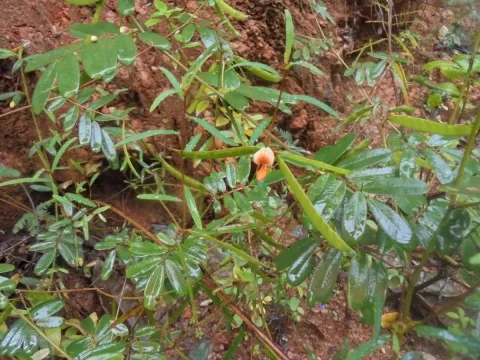
Tephrosia senticosa
Tephrosia senticosa
Tephrosia senticosa is a tropical perennial legume that requires precise timing for sowing, typically just before the onset of the wet season. Matching the seeding date with predictable rainfall patterns is crucial for establishing a robust plant stand.
What the section contains
Tephrosia senticosa
Seed preparation is a vital agronomic step, as the hard seed coat often requires scarification to ensure uniform germination. Mechanical or chemical methods of scarification can significantly improve the emergence rate and seedling vigor in the field.
The optimal planting depth is approximately 2 to 4 centimeters. Shallow sowing ensures that seeds can access sufficient moisture without being susceptible to rapid drying out, while avoiding the risks associated with deep burial in heavy soils.
Row spacing depends heavily on the intended use; crops grown for biomass production are often planted in closer rows to maximize canopy closure. Conversely, crops intended for seed multiplication require wider spacing to encourage lateral branching and pod development.
Early-stage weed control is essential because the crop exhibits a relatively slow initial growth rate. Maintaining weed-free conditions during the first few weeks allows the seedlings to establish a strong root system, which is vital for later productivity.
This species belongs to the Fabaceae family and thrives in a variety of soil types, particularly well-drained loams and sandy soils. Its ability to fix atmospheric nitrogen makes it an excellent choice for low-input agricultural systems and soil restoration.
As a light-demanding crop, Tephrosia senticosa requires full sun exposure to reach its physiological potential. Any form of shading from surrounding vegetation or neighboring trees will lead to reduced biomass and lower seed set.
The plant performs best under warm tropical conditions, with temperatures ranging between 25 and 32 degrees Celsius. It is highly sensitive to cold weather and frost, which can cause severe damage or complete mortality to the entire plant population.
While exhibiting reasonable drought tolerance, the crop benefits significantly from consistent moisture during its peak vegetative phase. Providing supplemental irrigation in arid regions can greatly enhance the overall yield and consistency of the harvest.
Proper soil management involves ensuring an adequate supply of phosphorus and potassium during the pre-planting phase. These nutrients are critical for the nodulation process, which enables the plant to fix nitrogen effectively and sustain healthy growth.
Common pests affecting this legume include pod borers and various leaf-eating beetles that can cause significant damage to the foliage and developing fruit. Integrated pest management strategies are often required to maintain yield levels.
Fungal diseases related to root rot are common in fields with poor drainage or persistent waterlogging. Ensuring proper field leveling and soil structure management is the most effective way to prevent these soil-borne pathogens.
Nematode infestations can occasionally affect root health, especially when the crop is grown in sandy soils over multiple years. Rotating the crop with non-host species is highly recommended to manage nematode populations effectively.
Defoliating insects can be managed through biological control or selective applications of environmentally friendly insecticides during the early stages of infestation. Monitoring fields during the flowering period is critical for early detection.
Environmental stress, particularly extreme humidity accompanied by high temperatures, may encourage the spread of mildew. Ensuring good airflow within the canopy through proper spacing is an essential preventive practice in humid tropical climates.
Harvesting for green manure should take place at the peak flowering stage to ensure the highest nitrogen content in the plant biomass. Cutting the plants at this stage maximizes the beneficial impact on soil fertility for the subsequent crop.
Seed harvesting requires careful timing, as the pods are prone to dehiscence once they reach full maturity. Monitoring the color change of the pods is necessary to capture the seeds before they scatter naturally on the field.
Post-harvest processing involves drying the harvested material under shade to preserve the quality of the seeds. Once the moisture content drops to approximately 10-12 percent, the seeds should be cleaned and stored in cool, pest-free environments.
Mechanical harvesting is feasible using standardized equipment, provided the crop is planted in straight, evenly spaced rows. This significantly reduces labor costs and improves the efficiency of the entire operation compared to manual harvesting methods.
The final stage of the harvest cycle involves incorporating the remaining stubble into the soil. This practice not only returns organic matter to the field but also improves soil tilth and prepares the seedbed for the next planting season.