
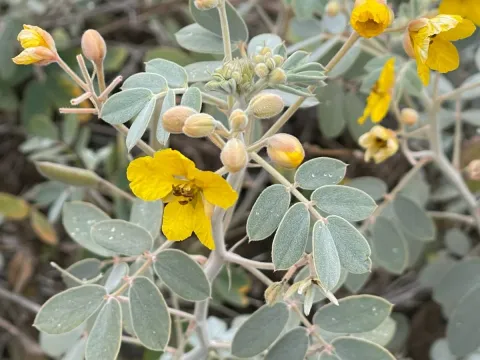
Senna covesii
Senna covesii
Senna covesii, commonly known as Coves' cassia, is a perennial subshrub belonging to the Fabaceae family. It is a classic xerophyte, highly adapted to survive in the arid environments of the southwestern United States and northern Mexico.
What the section contains
Senna covesii
Botanically, the plant is distinguished by its silvery-grey foliage, which acts as a protective layer against harsh desert sun. Its bright yellow, five-petaled flowers are a signature of the genus, appearing during the warmer months and attracting native pollinators.
The native habitat includes sandy flats, rocky slopes, and washes in the Sonoran Desert. Its evolutionary success depends on the ability to thrive with minimal water, making it an excellent candidate for xeriscaping and low-maintenance landscape design.
Successful cultivation requires soil that is extremely well-draining, such as sandy, gravelly, or rocky loam. Any soil mix that retains moisture for extended periods is unsuitable and will likely lead to the demise of the plant's root system.
Climatic requirements are specific to regions with hot, dry summers and mild winters. While it prefers full sunlight, some shade during the hottest part of the day can be beneficial for young, recently transplanted specimens to prevent heat stress.
Root rot is the most significant threat to Senna covesii, typically triggered by overwatering or poor drainage. Once root pathogens establish themselves, the plant is extremely difficult to save, emphasizing the need for a conservative irrigation schedule.
Pests such as aphids and spider mites may colonize the plants during periods of humidity or stress. Regular monitoring of the underside of the leaves is advised to detect early infestations before they spread across the entire shrub.
Weed competition can significantly inhibit the growth of young plants. Since Senna covesii grows slowly during the establishment phase, manual removal of invasive grasses or weeds surrounding the base is necessary to ensure adequate access to nutrients.
Fungal leaf spots can occur if the plant is grown in areas with poor airflow. Providing adequate spacing between individual plants ensures that the foliage dries quickly after rare rain events, significantly reducing the risk of fungal infections.
Temperature fluctuations and frost can impact survival in areas outside its native range. While mature plants are surprisingly cold-hardy, extreme freezing of wet soil is the primary cause of winter mortality; therefore, site selection and drainage remain the most critical protective measures.