
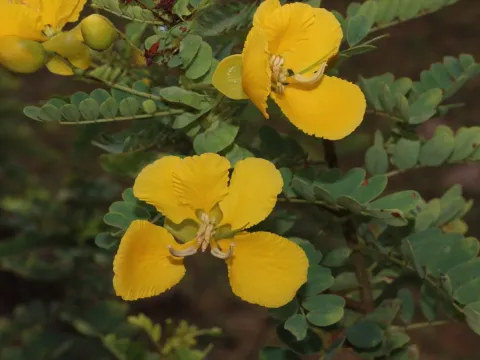
Senna auriculata
Senna auriculata
Sowing of Senna auriculata is typically timed to coincide with the beginning of the rainy season to ensure optimal moisture for germination. Seeds are often scarified before planting to break their dormancy and increase the germination rate significantly.
What the section contains
Senna auriculata
The plant thrives when sown in soil temperatures ranging from 25 to 30 degrees Celsius. In a commercial setting, seeds are placed in rows spaced about 60-90 centimeters apart to provide ample space for plant development.
Transplanting seedlings is a viable alternative to direct seeding, which allows for better early-stage management. Seedlings should be transferred to the field once they reach a height of 15-20 centimeters to ensure strong establishment.
Care should be taken not to bury the seeds deeper than 3 centimeters, as this ensures rapid emergence. After sowing, the soil should be lightly firmed to maintain good seed-to-soil contact.
Since the species is a fast-growing shrub, it quickly establishes a strong root system, which helps in resisting early environmental stresses after planting.
Senna auriculata is a member of the Fabaceae family and prefers well-drained, light-textured soils. While it can adapt to poor soil conditions, it shows peak productivity in fertile, loamy soils with a neutral pH level.
The plant is highly heliophilic and requires full sun exposure throughout the day for healthy growth and high concentrations of secondary metabolites in its leaves.
It possesses remarkable drought resistance, making it suitable for cultivation in arid or semi-arid regions. However, supplemental irrigation is recommended during extended dry spells to maximize biomass yield.
The climate must be tropical or subtropical, as the plant is sensitive to freezing temperatures. Frost can cause severe damage to the branches and might kill younger, less established plants.
Soil management must prioritize drainage, as waterlogging is a primary stress factor that can lead to root system decay. Maintaining a clean field free of standing water is essential for long-term health.
The primary commercial interest lies in the leaves and tender shoots of the shrub. Harvesting is most efficient when conducted through regular pruning, which promotes vigorous vegetative regrowth.
The first harvest can usually take place 6 to 8 months after establishment, depending on local weather conditions. Consistent pruning keeps the plants at a manageable size while ensuring a continuous supply of fresh material.
Post-harvest processing involves drying the material in the shade with good air circulation to preserve its chemical profile. Avoid direct sunlight during drying to prevent the degradation of heat-sensitive compounds.
In addition to leaves, the flowers are often harvested for their traditional medicinal applications. This adds to the overall economic potential of the plantation.
Plantations typically remain productive for several years before a decline in vigor is observed, at which point replanting is necessary to sustain profitable production levels.
The shrub is generally resilient to many pests due to the chemical components found in its foliage. However, fungal diseases can occur in humid conditions, particularly if air circulation is restricted.
Nematodes can pose a threat to the root system, especially in soils that are frequently kept too moist. Crop rotation and maintaining soil health are the best preventative measures against soil-borne pathogens.
Leaf-eating insects may appear during the growth season, though they rarely cause economic losses requiring chemical intervention. Biological controls are usually sufficient for managing such infestations.
Improper storage is the most significant risk to the quality of the final product, as mold can quickly spoil the dried leaves. Monitoring moisture content post-drying is a critical quality control step.
- Regular weeding to reduce competition for nutrients.
- Pruning of dead or diseased branches to improve airflow.
- Monitoring for pest presence during the main vegetative flush.