
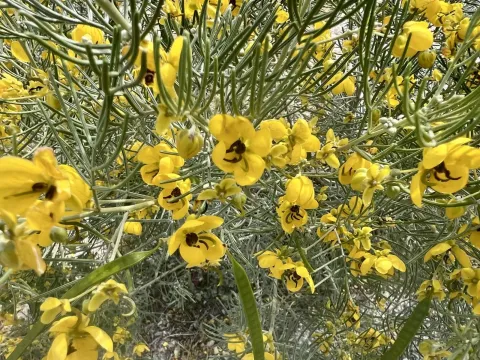
Senna artemisioides
Senna artemisioides
Senna artemisioides is typically propagated through seeds or semi-hardwood cuttings. Seeds have a hard coat and benefit significantly from scarification prior to planting.
What the section contains
Senna artemisioides
The ideal time for sowing is early spring in a greenhouse or controlled environment to maximize the photoperiod and ensure vigorous initial growth.
When sowing outdoors, it is essential to wait until the soil is consistently warm, as seedlings are highly susceptible to dampness and cold stress.
Seeds should be placed at a depth of about 0.5 cm in a sandy, well-draining soil mix to encourage a strong taproot development early in the lifecycle.
Transplanting into larger containers should be done carefully to avoid disturbing the root system, which is delicate during the early developmental stages.
Originating from the arid regions of Australia, this member of the Fabaceae family is uniquely adapted to high heat and water-limited environments.
The plant requires full sun exposure to maintain its characteristic silvery foliage and to support the profuse production of yellow flowers during the season.
It thrives in poor, sandy, or rocky soils that provide excellent drainage, as the species is highly intolerant of waterlogged or stagnant conditions.
While extremely drought-tolerant once established, providing occasional deep irrigation during the peak growing season helps ensure optimal plant health.
The species is frost-tender and requires a sheltered position in areas prone to freezing temperatures, making it unsuitable for very cold climates without protection.
The most significant threat to Senna artemisioides is root rot caused by soil compaction or overwatering, which quickly leads to plant collapse.
Pest issues often include aphids and spider mites, which tend to congregate on young foliage and stems during periods of low humidity or stress.
Integrated pest management, including the use of neem oil or soft soaps, is recommended for controlling infestations without harming beneficial pollinators.
Powdery mildew may occur if the plant is kept in humid conditions with poor air circulation, necessitating a change in the site environment.
Maintaining a clean growing space and removing any debris around the base of the plant can significantly reduce the risk of secondary infections.