
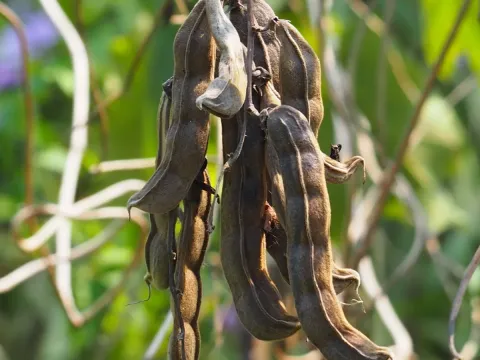
Mucuna deeringiana
Mucuna deeringiana
Mucuna deeringiana is a thermophilic legume, so its sowing time is strictly tied to the establishment of consistently warm weather. Planting should only be carried out after the soil at the seeding depth has warmed up sufficiently and the threat of late frosts has passed completely.
What the section contains
Mucuna deeringiana
The optimal time for planting is the period following the spring rains, when night temperatures do not drop below 15–18 degrees Celsius. Early sowing in cold soil leads to seed rot and uneven germination.
Seeds are sown using row or hole methods, maintaining adequate distance between plants, as the crop has powerful growth potential. In intensive farming, transplanting seedlings is an option for regions with shorter growing seasons.
Scarification of seeds is recommended before sowing, as the thick seed coat can delay germination. Soaking in growth stimulants contributes to more uniform and vigorous emergence in field conditions.
When grown as a green manure, seeding rates are increased to create a dense carpet capable of effectively suppressing weed growth throughout the plot.
The plant belongs to the Fabaceae family and is valued for its ability to adapt to poor soils. It thrives best in light, well-drained sandy loam or loamy soils with a neutral or slightly acidic pH balance.
Mucuna is highly demanding of heat and sunlight, preferring open areas protected from cold winds. The plant does not tolerate waterlogging, so sites with high water tables are unsuitable for its development.
To produce significant biomass, the crop requires sufficient moisture during the first half of the vegetative period, although mature plants demonstrate moderate resistance to short-term dry spells.
An important requirement is the provision of support or sufficient space, as this is a robust climber capable of outcompeting other plants. In agronomy, it is often utilized as a ground cover to combat soil erosion.
The plant actively forms symbiotic relationships with nitrogen-fixing bacteria, allowing it to capture atmospheric nitrogen and significantly improve soil fertility for subsequent crops in the rotation.
The biomass yield of Mucuna deeringiana is among the highest of all tropical legume crops. Under favorable vegetative conditions, it is capable of producing impressive amounts of organic matter in a short period.
When used as a green manure, the return of organic matter can reach significant levels, effectively replacing large doses of mineral nitrogen fertilizers. Exact figures depend on planting density and soil fertility levels.
Seed yield depends on the duration of the growing season and the success of insect-mediated pollination. On a commercial scale, grain harvesting is performed once pods have turned dark to prevent premature shattering.
For fodder purposes, the plant is harvested before stems become overly lignified, ensuring the best ratio of protein to fiber in livestock diets. Regrowth can provide additional cuttings if moisture is adequate.
Maximum productivity is achieved by maintaining optimal plant density, avoiding excessive overcrowding, which can lead to the development of fungal infections in the lower canopy.
Mucuna deeringiana possesses natural resistance to many diseases; however, improper agronomic practices can lead to root rot. This occurs most frequently in heavy, waterlogged soils with poor aeration.
Leaf spots may appear in conditions of high humidity and stagnant air within dense thickets. Prevention involves adhering to optimal spacing and ensuring proper ventilation of the field.
Regarding pests, various species of leaf-eating insects and caterpillars pose the greatest threat, as they can significantly reduce the plant's photosynthetic leaf area during early growth stages.
Root system damage from nematodes occurs in regions with hot climates, requiring the inclusion of this crop in proper crop rotations to break the pathogen's life cycle.
To control pests in organic farming, biological insecticides are used, which effectively suppress insect activity without accumulating toxic residues in the plant biomass.
Harvesting green biomass is conducted by shredding the stems and incorporating them into the soil as green manure. The best effect is achieved by mowing before the onset of mass seed maturity, when nitrogen concentration in the tissues is at its peak.
When harvesting seeds, collection begins when the pod valves turn a characteristic dark color and start to dry. It is critical to avoid delays, as the beans shatter easily upon reaching full maturity.
Mechanical harvesting requires the use of specialized headers adjusted for handling highly branched vines. Pre-harvest desiccation can significantly simplify the collection process in the field.
After collection, seeds must undergo thorough cleaning and drying to reach optimal storage moisture. Storage is carried out in cool, dry facilities protected from pests.
If grown for livestock feed, the plant is used fresh, ensiled, or dried into hay. Hay from Mucuna is characterized by high nutritional value and is readily consumed by agricultural animals.