
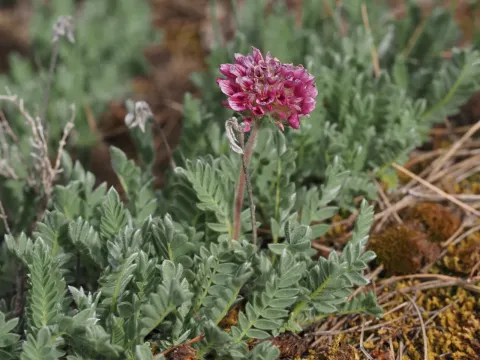
Mountain Kidney Vetch
Anthyllis montana
Mountain Kidney Vetch (Anthyllis montana) is a perennial legume highly valued for its hardiness. Planting is best performed in early spring as soon as the soil reaches a temperature of 5–8 degrees Celsius, ensuring optimal germination rates.
What the section contains
Mountain Kidney Vetch
For best results, the seedbed must be fine and firm. Due to the small size of the seeds, they should be sown at a shallow depth of 1–2 centimeters, ensuring they maintain good contact with soil moisture.
This species is often integrated into pasture seed mixtures to improve the nutritional value of forage. The seeding rate should be adjusted based on seed purity and local climatic conditions to ensure uniform stand density.
Row seeding with an interval of 15–20 centimeters is recommended, allowing for easier weed management during the establishment phase. Proper spacing helps seedlings compete effectively against annual weeds.
Early sowing takes advantage of spring soil moisture, which is critical for developing a robust root system before the onset of summer drought periods.
The culture is remarkably resilient, thriving in harsh, stony environments where other crops struggle. It prefers well-drained, calcareous, or rocky soils with a neutral to slightly alkaline pH level.
Mountain Kidney Vetch is known for its high drought and winter hardiness, making it suitable for volatile mountainous and continental climates. It requires full sunlight exposure to maintain vigorous growth and flowering.
Waterlogged or heavy clay soils are unsuitable, as they inhibit root development and the activity of beneficial nitrogen-fixing bacteria. Its deep taproot allows the plant to access water deep within the soil profile.
By fixing atmospheric nitrogen, this legume significantly contributes to soil fertility. It is an excellent choice for revegetation projects, particularly on degraded or nutrient-poor land surfaces.
Once established, the crop requires minimal intervention, as it is well-adapted to surviving on low-input, extensive agricultural land.
The biomass productivity of Mountain Kidney Vetch provides a valuable resource for high-quality hay production. The yield varies depending on soil fertility, moisture availability, and the age of the stand.
Productivity typically peaks in the second and third years of growth. This crop provides early-season green forage, which is vital for filling feed gaps before other pasture grasses reach maturity.
The nutritional profile of the forage is rich in proteins and minerals, making it an excellent feed source for livestock. Regular utilization helps improve the overall health and productivity of grazing herds.
Seed yield depends on pollinator activity and weather conditions during the flowering phase. Harvesting at the right time is crucial to maximizing the seed yield and preventing excessive shattering.
In addition to its role as a forage crop, its ability to stabilize slopes and prevent erosion provides significant economic value, particularly for land management in hilly regions.
Mountain Kidney Vetch is naturally resistant to many common legume diseases, which minimizes the need for synthetic chemical treatments. Maintaining proper drainage is the most effective preventative measure against fungal infections.
Insects like weevils or aphids may target reproductive organs during the budding stage. Field monitoring should be conducted periodically to detect and manage potential outbreaks at early stages.
Crop rotation and keeping fields free of dense weed competition reduce the likelihood of pest infestations. A healthy, well-ventilated stand is generally less susceptible to pathogens.
Avoid excessive nitrogen fertilizer application, as it can weaken the plant and make it more attractive to certain types of foliage-eating insects. Cultural control remains the first line of defense.
In cases of severe infestation, biological controls are preferred to preserve the forage quality and environmental safety of the agricultural site.
Harvesting for green forage should occur at the early flowering stage. Cutting at this time ensures the highest concentrations of digestible nutrients, vitamins, and proteins within the plant tissues.
It is important to leave a stubble height of at least 5–7 centimeters when mowing to protect the plant's growing points and ensure rapid regrowth for subsequent cuttings during the season.
When producing hay, careful drying is essential to prevent leaf shatter, as leaves contain the majority of the crop's nutritional value. Tedding should be performed gently to ensure even drying.
Seed harvesting should be timed when the majority of the pods have matured and changed color. Rapid collection is necessary to minimize harvest losses caused by natural seed shattering.
Modern harvesting machinery adapted for uneven terrain increases operational efficiency, allowing for easier maintenance of pastures and meadows where Mountain Kidney Vetch is established.