
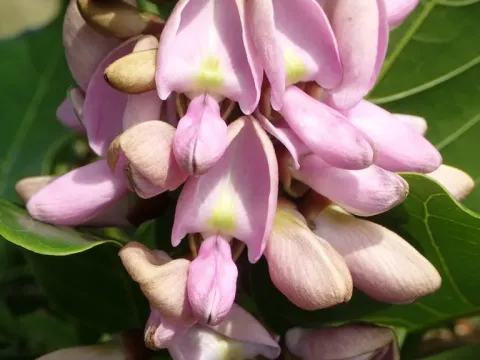
Millettia
Millettia
Millettia is a diverse genus of leguminous plants, comprising trees, shrubs, and lianas, native primarily to tropical and subtropical regions across Asia and Africa. These plants are valued for their ecological role and chemical constituents found in various parts of the plant.
What the section contains
 Japanese Millettia
Millettia japonica
Millettia caudata
Millettia caudata
Millettia chrysophylla
Millettia chrysophylla
Millettia drastica
Millettia drastica
Japanese Millettia
Millettia japonica
Millettia caudata
Millettia caudata
Millettia chrysophylla
Millettia chrysophylla
Millettia drastica
Millettia drastica
 Millettia dura
Millettia extensa
Millettia extensa
Millettia dura
Millettia dura
Millettia extensa
Millettia extensa
 Millettia ferruginea
Millettia ferruginea
Millettia ferruginea
 Millettia grandis
Millettia grandis
Millettia grandis
 Millettia griffoniana
Millettia lane-poolei
Millettia lane-poolei
Millettia griffoniana
Millettia griffoniana
Millettia lane-poolei
Millettia lane-poolei
 Millettia leucantha
Millettia leucantha
Millettia leucantha
 Millettia merillii
Millettia merillii
Millettia merillii
 Millettia pachycarpa
Millettia pallens
Millettia pallens
Millettia psilopetala
Millettia psilopetala
Millettia pachycarpa
Millettia pachycarpa
Millettia pallens
Millettia pallens
Millettia psilopetala
Millettia psilopetala
 Millettia pulchra
Millettia pulchra
Millettia pulchra
 Millettia rhodantha
Millettia rubiginosa
Millettia rubiginosa
Millettia rhodantha
Millettia rhodantha
Millettia rubiginosa
Millettia rubiginosa
 Millettia sericea
Millettia sericea
Millettia sericea
 Millettia thonningii
Millettia warneckei
Millettia warneckei
Millettia thonningii
Millettia thonningii
Millettia warneckei
Millettia warneckei
 Millettia zechiana
Millettia zechiana
Millettia zechiana
 Panga Panga
Millettia stuhlmannii
Panga Panga
Millettia stuhlmannii
 Wenge
Millettia laurentii
Wenge
Millettia laurentii
Millettia
The timing of sowing depends on the regional climate, typically aligned with the onset of the rainy season. Adequate soil moisture at the beginning of the growth cycle is crucial for the successful establishment of the root system in tropical climates.
Propagation is generally performed via seeds or stem cuttings. Seed propagation often requires pre-treatment, such as mechanical scarification, to overcome dormancy caused by the hard seed coat and to improve overall germination uniformity.
Selection of the site for planting should prioritize well-drained soils, as waterlogging can cause root decay. Millettia thrives in warm, humid conditions and is highly intolerant to frost, which limits its commercial cultivation to frost-free latitudes.
The spatial arrangement in plantations varies according to the end-use of the crop. For biomass production, a higher density is preferred, whereas for seed harvesting, wider spacing is essential to ensure maximum exposure of the canopy to sunlight and optimal nutrient distribution.
Millettia requires consistent warmth, with optimal growth temperatures ranging between 22 and 32 degrees Celsius. The crop is highly sensitive to cold, making it unsuitable for areas experiencing temperature drops near freezing point.
Soil quality significantly impacts growth rates. The plant prefers deep, fertile, and well-aerated sandy loam or loam soils. Being a legume, it forms symbiotic relationships with soil bacteria, which helps in nitrogen fixation and improves soil fertility.
Light intensity is a critical factor for the development of both the vegetative and reproductive stages. While some species show tolerance to partial shade in their natural habitat, intensive cultivation requires full solar exposure to maximize yields of specialized biochemical compounds.
Regular maintenance involves keeping the base of the plants clear of invasive weeds during the early developmental phases. Mulching is highly effective in maintaining soil moisture levels and regulating temperature near the root zone, especially during brief dry spells.
Fertilization strategies should focus on maintaining a balanced nutrient supply. While nitrogen-fixing properties support the plant's growth, supplemental phosphorus and potassium are essential for healthy flower and seed production, particularly in commercial nursery or field settings.
Millettia species contain naturally occurring insecticides known as rotenoids, which provide a significant level of innate protection against many herbivores. This characteristic makes the plant relatively resistant compared to many other leguminous crops.
However, fungal diseases, particularly root rots, can occur if the drainage is poor or if high humidity persists around the plant base for extended periods. Proper ventilation and canopy management are vital to mitigating these moisture-related risks.
Leaf-eating caterpillars and aphids may occasionally attack young, tender foliage. Integrated Pest Management (IPM) practices, including the use of pheromone traps or biological control agents, are recommended to preserve the integrity of the ecosystem.
Soil-borne pathogens may pose a threat if the site has a history of monoculture or poor soil management. Rotation and the use of healthy, certified seeds are fundamental practices to prevent the introduction of pathogens into a new plantation.
Maintaining the overall vitality of the stand through optimal irrigation and balanced nutrition is the best defense against threats. Healthy plants are better able to withstand environmental stressors and minor infestations, ensuring consistent productivity over time.