
Millettia grandis
Millettia grandis
Description
Sowing dates
Millettia grandis, a member of the Fabaceae family, is a slow-growing evergreen tree primarily native to the coastal forests of South Africa.
Propagation is generally achieved through seeds, which require careful handling due to their hard seed coat that restricts water uptake during the initial phase.
Scarification, involving light sanding or soaking, is recommended to improve germination rates when sowing in nursery beds or containers.
The ideal planting medium should be well-draining, rich in organic matter, and kept in a warm environment to facilitate rapid root development after sowing.
Seedlings are sensitive to transplanting shock, so it is best to raise them in deep pots before placing them into their permanent location in the field.
Growing requirements
This species thrives in warm, frost-free climates and requires consistent temperatures to maintain active growth throughout the year.
It prefers deep, fertile, and slightly acidic soils, although it demonstrates a high tolerance for varying soil textures as long as drainage is excellent.
Young trees benefit significantly from partial shade, which protects them from excessive heat stress while they establish their root systems.
Proper airflow is critical, as this tree is naturally accustomed to the breezy coastal conditions where it originates, preventing foliage moisture buildup.
Being a legume, Millettia grandis forms symbiotic relationships with nitrogen-fixing bacteria, reducing the need for intensive nitrogen fertilization.
Yield
The primary economic output of Millettia grandis is its dense, durable wood, which is highly prized in fine woodworking and furniture manufacturing.
Beyond timber, the tree serves as an essential component in agroforestry systems, contributing to soil health through nitrogen fixation and erosion control.
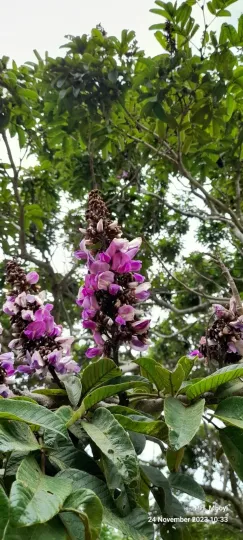
In landscaping, its aesthetic value lies in its vibrant purple-to-maroon flower spikes, which attract various pollinators to the surrounding ecosystem.
Though wood production is a long-term goal, the environmental services provided by the tree, such as windbreak protection, offer immediate utility.
Selective harvesting of timber ensures the longevity of the stand, allowing for a sustainable supply of wood without degrading the local forest environment.
Main diseases and pests
The most common threats include root rot pathogens, which thrive in waterlogged soil conditions and can rapidly weaken the tree's internal structures.
Defoliating insects can significantly reduce the photosynthetic capacity of the tree, potentially slowing its growth rate during the peak season.
Spider mites and scale insects are known to affect leaves and stems during prolonged dry periods, necessitating vigilance and timely monitoring.
Fungal leaf spot diseases may appear in humid environments, especially if there is insufficient spacing between trees to allow for adequate ventilation.
- Use of organic fungicides when needed.
- Manual removal of affected plant parts.
- Maintaining optimal soil drainage.
- Encouraging natural predators of common pests.
Harvesting
Seed harvesting should be timed precisely when the pods turn brown and start to split, indicating maturity and high seed viability.
Manual collection is the preferred method to prevent seed loss and damage, ensuring only the healthiest seeds are selected for propagation.
Timber harvesting requires careful planning, focusing on mature trees that have reached their full density and optimal structural strength.
After felling, the logs should be air-dried in a sheltered, well-ventilated area to reduce the moisture content and prevent checking or splitting.
Seeds meant for future use must be stored in cool, dry conditions to avoid mold and maintain their germination capacity for the next planting cycle.