
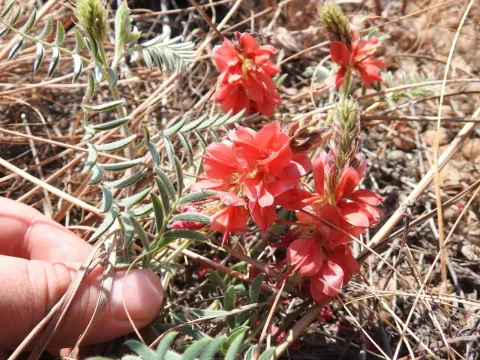
Indigofera oxytropis
Indigofera oxytropis
Indigofera oxytropis is a perennial plant belonging to the Fabaceae family. It is recognized for its agricultural potential as a legume capable of fixing atmospheric nitrogen in the soil.
What the section contains
Indigofera oxytropis
Planting is typically performed during the spring season when soil temperatures are stable, ensuring favorable conditions for seed germination and initial root establishment.
Due to the hard seed coat characteristic of many legumes, mechanical scarification is recommended before sowing to improve water absorption rates and ensure uniform field emergence.
The optimal planting depth is approximately 2 to 3 cm, allowing the seedlings to establish themselves without depleting their energy reserves before reaching the surface.
Spacing between rows should be maintained to ensure proper airflow and sunlight penetration, which helps reduce the risk of fungal proliferation within the crop canopy.
This crop is highly photophilic, meaning it requires abundant sunlight for optimal biomass production and metabolic function. Shaded areas are unsuitable for its cultivation.
The species exhibits remarkable drought resistance, allowing it to survive in regions with irregular rainfall patterns, provided the soil structure supports deep root penetration.
It prefers well-drained, light-textured soils such as sandy loams. Heavy clay soils that tend to compact or waterlog should be avoided to prevent root system damage.
Soil pH levels should ideally be maintained between 6.5 and 7.5. Adjusting soil acidity through liming is essential if the substrate is too acidic for effective legume growth.
Balanced fertilization, particularly with potassium and phosphorus, strengthens the plant's structural integrity and enhances its ability to withstand environmental stress.
Fungal diseases, including powdery mildew and leaf spot pathogens, are the primary threats, especially under conditions of high humidity and poor ventilation.
Effective management strategies include crop rotation and ensuring optimal spacing to prevent the creation of microclimates favorable for fungal spore development.
Insect pests, such as aphids and various types of weevils, can cause damage by feeding on young leaves and floral buds, thereby reducing overall crop vigor.
Regular field scouting is necessary to identify early signs of pest infestation, allowing for targeted intervention if population thresholds are exceeded.
Integrated pest management (IPM) practices, emphasizing biological controls, are recommended to minimize reliance on chemicals and maintain soil ecosystem health.