
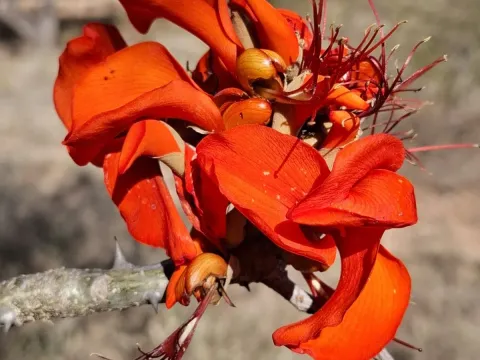
Velvet coralbean
Erythrina velutina
Propagation of Erythrina velutina is typically achieved through seeds or vegetative cuttings. Seeds possess a hard seed coat, and scarification or soaking in warm water for 12–24 hours is highly recommended to improve germination rates.
What the section contains
Velvet coralbean
The optimal time for sowing in nurseries is the beginning of the rainy season, ensuring adequate moisture for growth without additional irrigation. Seedlings are transplanted to their permanent locations once they reach a height of 40–60 centimeters.
For vegetative propagation, semi-hardwood cuttings are used, which are planted directly into moist soil. Survival rates for these cuttings exceed 80% when proper temperature and moisture conditions are maintained.
Planting density varies based on the intended use: for living fences or windbreaks, plants are spaced 1–2 meters apart. When establishing fodder plantations, the distance can be reduced to 0.5–1 meter.
Preparing planting pits of at least 40x40x40 cm is essential, with the addition of organic fertilizers to stimulate root system development during the early growth phase.
Erythrina velutina is a member of the Fabaceae family, native to the dry tropical forests and semi-arid regions of South America, particularly Brazil. It is renowned for its remarkable drought tolerance.
The crop adapts well to nutrient-poor soils and prefers well-drained sandy or loamy textures with a neutral to slightly acidic pH level. It thrives in open sunlight, which is necessary for canopy development and flowering.
The minimum temperature required for active growth is +18...+20°C, and the tree is highly sensitive to frost. During severe drought, the tree often sheds its leaves to enter dormancy as a survival mechanism.
Agronomically, this plant is valued for its nitrogen-fixing capabilities, which improve soil fertility. It integrates well into agroforestry systems, contributing to soil health through leaf litter decomposition.
While mature trees are capable of surviving long dry spells due to their deep root systems, young trees require moderate soil moisture during their first year of establishment to ensure proper growth.
The primary economic value of the velvet coralbean lies in biomass production for livestock fodder. The foliage and young shoots are rich in protein and are highly digestible for ruminants.
Productivity in terms of green biomass is significantly enhanced by intensive management and regular pruning. Periodic cutting stimulates branching, which increases the overall yield of nutritious fodder.
Seeds are also of interest, though their use requires specific preparation due to the presence of secondary metabolites that must be neutralized before being used in animal feed or other applications.
The wood of this species is light and soft, commonly used by local communities for handicrafts, lightweight furniture, and floats for fishing nets, providing a secondary revenue stream for farmers.
Green mass yields depend heavily on regular nitrogen supplementation, although the plant has a natural ability to fix atmospheric nitrogen to support its own metabolic processes.
Lepidopteran larvae are among the primary pests, as they can damage young leaves and terminal buds, significantly reducing the growth rate and overall biomass output of the plantation.
In high humidity and poor ventilation conditions, the tree is susceptible to fungal diseases such as powdery mildew or leaf spot. Proper canopy management is the best preventive measure.
Wood-boring insects may attack stressed or damaged trees; therefore, keeping the plantation in a healthy, well-maintained state is crucial for preventing secondary infestations.
Nematodes affecting the root system can pose a threat in areas where leguminous crops have been grown continuously for many years, necessitating the implementation of crop rotation strategies.
Excessive irrigation leading to waterlogged soil triggers root rot, a disease that is extremely difficult to manage once established, making proper soil drainage a non-negotiable requirement.
Harvesting green biomass is done through regular pruning of lateral branches. The ideal interval between cuttings ranges from 3 to 6 months, depending on regional climatic conditions and rainfall intensity.
During harvesting, it is vital to avoid damaging the main stem, as this can delay plant recovery and increase susceptibility to pests and diseases.
Seeds are harvested after the pods have fully matured and turned brown, just as they begin to split. The collected material should be dried in the shade to prevent mold and spoilage.
For industrial fodder production, harvesting foliage in the early morning is preferred to maintain optimal moisture levels, which facilitates better drying or ensiling processes.
All pruning tools must be sharp and disinfected to prevent the spread of pathogens between trees, ensuring the longevity and productivity of the agricultural site.