
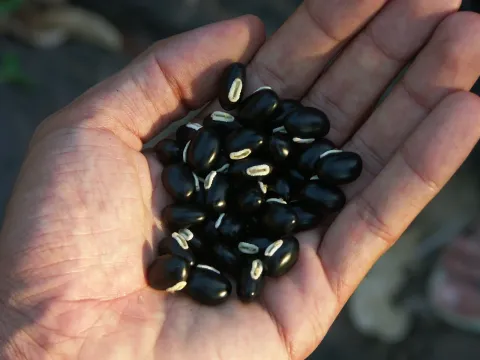
Velvet bean
Mucuna aterrima
Velvet bean is a highly heat-demanding crop that requires consistently warm temperatures to thrive. Planting should commence only when soil temperatures are stable, ideally above 20 degrees Celsius, and the threat of late spring frosts has completely passed.
What the section contains
Velvet bean
In tropical regions, the sowing process is timed to coincide with the onset of the rainy season to ensure sufficient moisture for seedling establishment. In temperate climates, cultivation is restricted to a single summer season due to the plant's inability to survive cold winters.
Seeding rates are adjusted based on the specific end-use, with higher densities typically applied when the crop is intended for weed suppression or green manure. Seeds are usually planted at a depth of 3 to 5 centimeters, depending on soil moisture and texture.
The crop displays vigorous early growth, allowing it to quickly canopy over the ground and outcompete most weed species. Early sowing is crucial to maximize the vegetative growth period before the onset of cooler autumn temperatures.
It is advised to avoid planting in waterlogged soils to prevent seed rot before germination occurs. In some cases, light scarification of the seed coat can be beneficial to ensure uniform and rapid emergence of seedlings.
As a member of the Fabaceae family, this plant acts as a robust vine with high biological plasticity. Its native range is found within tropical and subtropical zones, though its utility as a soil-improving crop has led to widespread distribution globally.
Mucuna aterrima favors well-drained, fertile soils but exhibits a remarkable ability to survive in poorer, acidic, or degraded landscapes. While it can withstand periods of limited water, optimal growth and biomass production occur with reliable moisture levels.
A key requirement for development is the provision of climbing structures, although the plant will naturally grow as a dense ground cover if no supports are present. This ground cover is highly effective at preventing soil erosion and cooling the surface.
The plant is intensely light-demanding and performs poorly in shaded environments. Adequate solar exposure is essential for maintaining the high metabolic rates required for its extensive nitrogen-fixing capabilities and biomass accumulation.
Biological nitrogen fixation is the most significant agronomic feature of this crop. Through its symbiotic relationship with rhizobia, it contributes substantial amounts of nitrogen to the soil, significantly enhancing the fertility profile for subsequent crops.
This legume is prized for its exceptional biomass production, often generating massive amounts of organic material per hectare. This high yield makes it an invaluable resource for land reclamation and soil regeneration programs in agricultural systems.
The primary economic uses include green manure, livestock forage, and organic mulch. Its ability to produce large quantities of leaf litter contributes to long-term soil structure improvement and nutrient cycling within the farm ecosystem.
When incorporated into the soil, the green biomass decomposes rapidly, releasing plant-available nutrients such as nitrogen and phosphorus. This process provides a natural alternative to synthetic fertilizers, promoting sustainable yield improvements for following crops.
Seed production depends on the length of the growing season and the presence of pollinating insects. While the seeds themselves hold nutritional value, proper processing is necessary due to the presence of natural anti-nutritional factors.
The crop shows consistent performance even under low-input management systems, making it highly attractive for smallholder farmers. Its yield potential is primarily limited by the frost-free duration of the local climate.
Velvet bean generally maintains a strong resistance to most common legume diseases. However, in extremely humid or stagnant air conditions, minor instances of fungal leaf spots may occur, which can be mitigated by ensuring proper planting spacing.
Pest pressure is often limited, though foliage-feeding insects can cause damage during the vegetative stage. Regular scouting of the field is recommended to prevent significant loss of the leaf canopy, which is vital for weed suppression.
Post-harvest storage pests, particularly weevils, pose the greatest threat to seed quality. Proper drying of the pods and storing seeds in airtight or treated containers are the most effective methods for protecting the harvest from damage.
Root diseases are rarely an issue unless the plant is grown in highly compacted or poorly drained soil. Maintaining soil health and implementing a diverse crop rotation cycle effectively prevents the buildup of soil-borne pathogens.
Given its strong natural immunity, the crop rarely necessitates the use of synthetic pesticides. This characteristic makes Mucuna aterrima an ideal candidate for low-impact and organic farming models, minimizing overall production costs.