
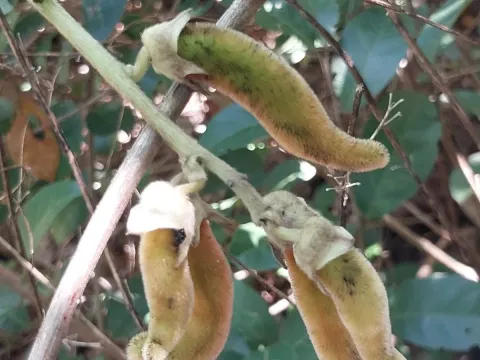
Velvet bean
Mucuna
Mucuna is a thermophilic crop, meaning it must be planted only when all risk of frost has passed and soil temperatures have reached at least 18–20°C.
What the section contains

Velvet bean
The optimal planting time coincides with the onset of the rainy season, which provides the necessary moisture for the seeds to germinate and the seedlings to establish rapidly.
Seeds should be sown at a depth of 3 to 5 centimeters, with row spacing maintained between 60 and 90 centimeters to allow for the plant's vigorous growth and trailing nature.
Inoculation with appropriate Rhizobium strains is highly recommended to enhance the plant's ability to fix atmospheric nitrogen and improve overall yield.
For cover crop applications, a denser sowing pattern is preferred to ensure full canopy closure, while seed production plots are spaced wider to facilitate easier harvesting.
As a member of the Fabaceae family, Mucuna is a vigorous annual climbing legume known for its exceptional ability to restore soil fertility.
The crop is highly adaptable to various soil types, including poor or acidic soils, but it performs best in well-drained loamy soils with a neutral pH.
Mucuna requires significant sunlight to thrive; shading or competition from other aggressive plants can severely hinder its biomass production.
While known for its drought tolerance once established, the crop requires consistent moisture during its rapid vegetative growth phase to maximize foliage production.
The ideal temperature range for Mucuna development is between 25°C and 35°C; growth is drastically slowed when temperatures fall below 10°C.
In terms of green manure production, Mucuna can yield between 20 and 40 metric tons of fresh biomass per hectare depending on the soil conditions and season duration.
It is capable of fixing up to 150 kg of atmospheric nitrogen per hectare, serving as a powerful natural fertilizer for subsequent cereal or cash crops in rotation.
Seed yields typically range from 1 to 2 tons per hectare, providing a nutrient-dense source of protein for livestock feed in specific agricultural systems.
The crop's rapid growth rate allows it to outcompete most common weeds, effectively acting as a living mulch that preserves soil moisture and suppresses unwanted vegetation.
The peak nutrient value and biomass accumulation are observed at the onset of flowering, making this the ideal time for incorporating the crop into the soil as green manure.
Young seedlings are particularly vulnerable to soil-borne pests such as wireworms and cutworms, which can cause significant stand loss in early stages.
High humidity and poor air circulation in thick canopies can promote the development of fungal diseases like anthracnose and powdery mildew.
Root-knot nematodes pose a persistent threat, especially in continuous cropping systems, potentially weakening the plant's root system and reducing nitrogen fixation efficiency.
Integrated pest management, including crop rotation and the use of healthy, treated seeds, is the primary defense strategy for commercial Mucuna growers.
- Leaf-eating caterpillars
- Root rot caused by waterlogging
- Bacterial wilt in tropical climates
When used as a green manure, the crop should be incorporated into the soil at the early flowering stage to maximize nutrient release before lignification occurs.
Seed harvest is conducted after the pods have fully matured and turned dark, with the plant foliage beginning to senesce and turn yellow.
Harvesting for seeds is labor-intensive and often requires specialized equipment to manage the extensive, entangled vine biomass and pod collection.
Post-harvest handling requires immediate and thorough drying of the seeds to prevent fungal contamination and ensure viability during long-term storage.
Care must be taken during the harvesting process as many varieties possess pod hairs that are highly irritating to human skin and respiratory passages.