
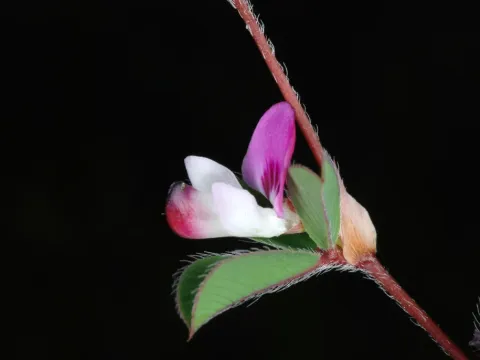
Kummerowia
Kummerowia
Kummerowia is an annual leguminous plant that requires precise timing for sowing to achieve optimal establishment and productivity. The ideal period for planting is early spring, once soil temperatures consistently exceed 12 to 15 degrees Celsius.
What the section contains


Kummerowia
The crop is typically sown in rows spaced 15 to 30 centimeters apart, depending on whether the intended harvest is for green fodder or hay production.
Due to the hard-seeded nature of the species, mechanical or chemical scarification is strongly recommended before sowing to ensure uniform and rapid germination across the field.
Seeds should be placed at a shallow depth of 1 to 2 centimeters to prevent exhaustion of the seedling before it reaches the surface, which is common in small-seeded legumes.
Post-sowing rolling is a critical practice to ensure adequate soil-to-seed contact, which helps retain surface moisture and promotes consistent seedling development.
Native to East Asia, Kummerowia has proven to be highly adaptable to various climatic zones, including temperate and subtropical regions with adequate rainfall.
The plant thrives in full sun and is sensitive to shading; therefore, it should not be grown as an understory crop or in areas with significant light competition.
Well-drained loamy or sandy soils with a near-neutral pH are ideal for this crop, as it does not tolerate waterlogged or highly acidic soil environments.
One of its standout features is superior drought tolerance compared to many other forage legumes, making it a valuable option for rehabilitating marginal or degraded land.
To maximize biomass production, the soil must contain appropriate Rhizobium bacteria, which form symbiotic nodules on roots to facilitate essential atmospheric nitrogen fixation.
Kummerowia is primarily valued as a high-protein forage crop that provides excellent nutrition for livestock, often replacing more sensitive legume varieties in specific rotations.
Under favorable growing conditions and good management, green mass yields can reach 15–25 tonnes per hectare, while hay yields typically range between 5–8 tonnes per hectare.
Beyond forage, the plant is widely utilized as a green manure or cover crop, effectively increasing soil organic matter and overall fertility through nitrogen enrichment.
Because the crop is capable of rapid regrowth after cutting, multiple harvests are possible within a single season if moisture availability remains consistent throughout the summer.
- Excellent digestibility for ruminants
- Significant nitrogen fixation capabilities
- High tolerance for poor soil conditions
- Effective suppression of certain weed species
The main pathological threats to the crop in humid conditions include powdery mildew and bacterial wilts, both of which can significantly diminish plant vigor and overall yield.
Pest pressures are often dominated by clover root curculios, which feed on root systems, causing structural damage and reducing the plant's efficiency in nitrogen fixation.
Aphids can also pose a problem during the early stages of growth, causing leaf curling and stunting by feeding on the sap of tender young shoots and stems.
Implementing a strict crop rotation strategy is the most effective management tool to minimize the accumulation of soil-borne pathogens and long-term pest issues.
Integrated pest management, focusing on biological and cultural controls, is encouraged over chemical alternatives to maintain the sustainability of the agricultural system.
For the highest quality green fodder, harvest should occur at the peak of the flowering stage, before the plant allocates too much energy toward seed development.
When producing hay, rapid and careful drying is essential to prevent leaf shatter, as the leaves contain the vast majority of the protein and vitamins sought by producers.
Delaying the harvest beyond the optimal window results in stem lignification, which severely lowers the nutritional value and palatability of the harvested forage for animals.
Seed harvesting should be timed for when the pods turn dark and reach physiological maturity, requiring combine headers to be set gently to avoid shattering the brittle pods.
After harvesting, seeds must be cleaned and dried down to a low moisture content to prevent fungal growth and ensure high viability for subsequent planting cycles.