
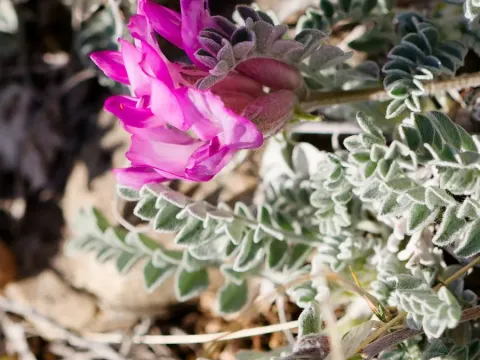
Utah milkvetch
Astragalus utahensis
Utah milkvetch (Astragalus utahensis) is a hardy perennial plant belonging to the Fabaceae family, native to the arid mountain regions and plateaus of the western United States.
What the section contains
Utah milkvetch
This species is highly adapted to extreme temperature fluctuations and thrives in environments where many other forage legumes fail to establish.
The plant prefers well-drained, sandy or gravelly soils with an alkaline pH, reflecting its natural habitat on limestone or rocky slopes.
Exposure to full sun is essential for the healthy development of this species; it does not tolerate competition from tall vegetation or shaded sites.
It is characterized by deep taproots, which allow the plant to survive prolonged dry spells, making it a robust candidate for xeriscaping and soil conservation.
Seeds of Astragalus utahensis possess a hard seed coat and require scarification or cold stratification to break dormancy and ensure uniform germination.
The ideal sowing window is late autumn, allowing the seeds to undergo natural winter chilling, or early spring after the threat of severe frost has passed.
Sowing depth should be kept shallow, approximately 1 to 2 centimeters, to prevent exhausting the seed's energy reserves before emergence.
For agricultural or restoration purposes, seeds are often drilled into prepared soil beds, ensuring proper seed-to-soil contact for optimal moisture absorption.
Growth during the first season is typically slow as the plant invests significant energy into developing its underground root structure before significant foliage expansion.
The primary agricultural utility of Utah milkvetch lies in its role in restoring degraded rangelands and stabilizing erosion-prone slopes.
Seed harvest is conducted when the seed pods turn dark brown, often requiring multiple passes to prevent seed dispersal caused by natural pod dehiscence.
As a notable pollinator plant, it provides essential nectar and pollen for native bees during the early spring and summer months.
While not a primary commercial forage crop, its inclusion in range mixtures can improve the overall biodiversity and nutritional profile of grazing lands.
The harvest of vegetative material is generally avoided during the first two years to allow the population to establish a sustainable perennial presence.
Root rot pathogens represent the most significant threat, especially when the soil remains saturated for extended periods, leading to hypoxia in the root zone.
Various coleopteran pests and aphids may damage the succulent leaves and developing buds, reducing the plant's overall reproductive success.
Powdery mildew can emerge in humid, poorly ventilated environments, potentially inhibiting photosynthesis and reducing plant vigor.
Rodent activity in winter can damage the crown of the plant, leaving it vulnerable to secondary fungal infections during the spring thaw.
- Selection of well-drained planting sites.
- Effective seed scarification protocols.
- Monitoring of seasonal insect populations.